Chapter 4: Participants
Seven children participated in the research, four from the preschool total communication hearing-impaired class and three from the preschool oral hearing-impaired class. The degrees of hearing loss for the children ranged from moderate to profound. Their hearing losses and their ages at key points in their lives in relation to the losses as well as their ages at the start of educational services are included in the description sections for each child.
Two of the children, Janine and Michael, were in different classes the year prior to the research—Janine was in the total communication class while Michael spent five months in the oral class before Cathy transferred him to the total communication class. The children in the oral class were Jon, Janine, and Billy. Darrell, Michael, David and Jeffrey were in the total communication class.
Jon and Billy were the only children in the study who communicated only with oral language. All of the others used some degree of signed English, although Darrell and Janine used limited signs. Michael communicated through speech and signed English, while Jeffrey communicated through signs and David used mostly gestures and signs.
In addition to signs and speech, the children used gestures, body movements, and facial expressions to communicate. Gestures included pointing and invented signs, whereas body movements were actions such as head nodding, acting out expressions and situations, and physically communicating with others through taps, pulls, and other similar actions.
The children expressed themselves through facial expressions such as lifted eyebrows, open mouths, and grimaces. Unlike hearing children, these gestures, body movements, and facial expressions did not just supplement the children’s verbal communications—for most of the hearing-impaired children, they constituted a primary form of communication.
The group of children studied represented a cross-section of the general population. The children came from a range of SES backgrounds with varied ethnicity, including one child from a bilingual home (Spanish-English). Of the seven children in the study, only two lived in two-parent homes. Based on analyses of the data from the research, economic levels and family structures did not have any effect on the children’s literacy development. Further, the modes of communication used by the children and their parents seemed to make no difference in the children’s growth in literacy. What did seem to make a difference, particularly in the children’s writing development, was prior or concurrent schooling. Both Janine and Michael attended nursery schools for hearing children in addition to the preschool hearing-impaired class and they seemed to demonstrate more sophisticated knowledge of written language.
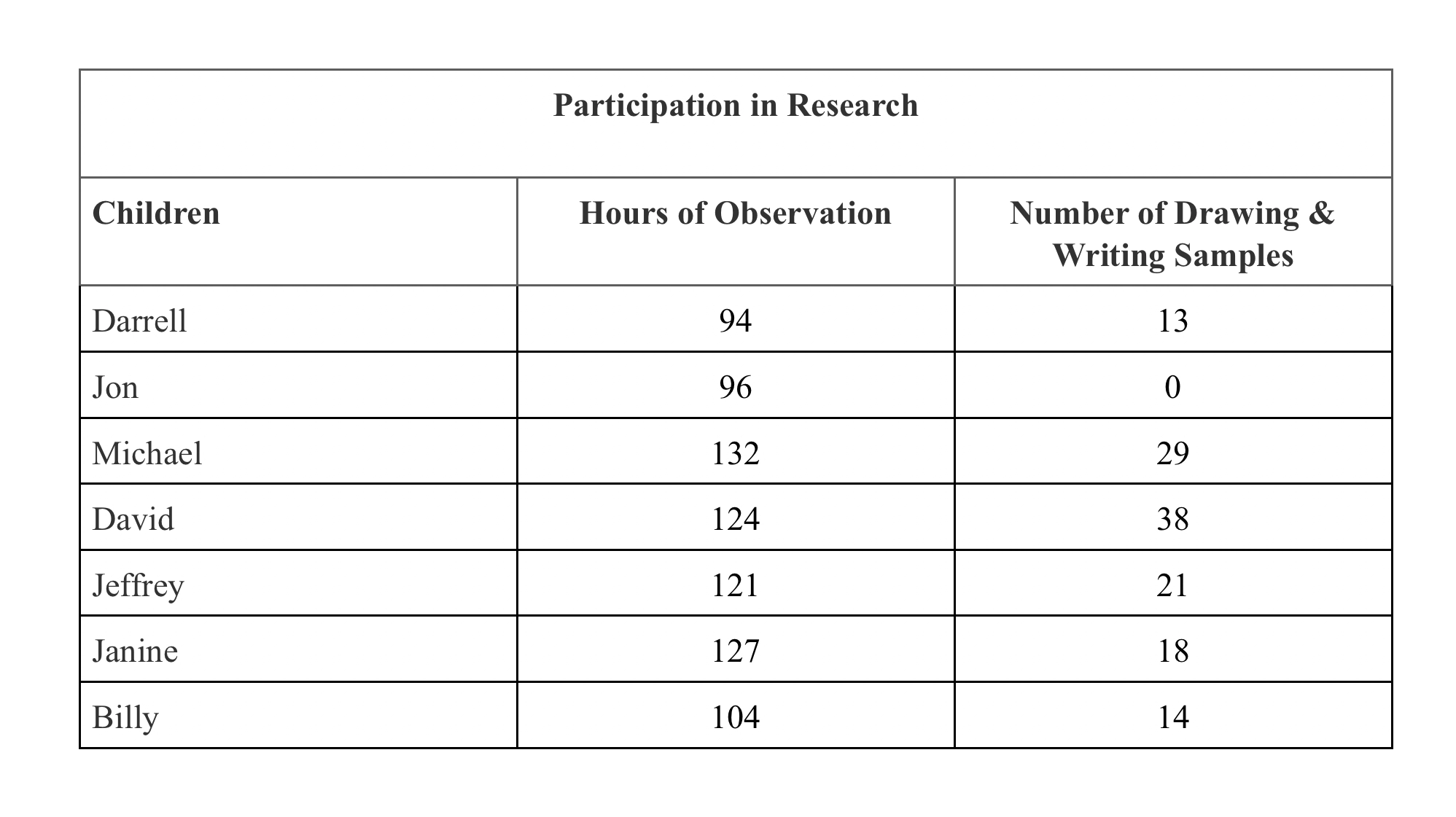
The following table shows the number of hours of observation of each child and the number of drawing and writing samples collected.
Darrell
Darrell was first diagnosed with a hearing loss and aided at the age of three. His educational support also began at that age. He entered the hearing-impaired program at the age of three years and four months. He had a profound hearing loss (90 dB) in both ears.
Darrell was an adorable child who learned early in life how to charm people and win their acceptance and approval. One of the first signs Darrell learned to use spontaneously was the American Sign Language one-hand sign for “I love you.” He used this sign when he wanted attention or just needed a hug from one of the adults in the room. Although all of the children were, at times, affectionate, what set Darrell apart from them was his warmth and his ability to share that warmth with others.
In addition to being a very affectionate child, Darrell was extremely social. This was probably due, at least in part, to the structure of his family and home life. He had one older sibling (five years old at the start of the study) and two younger siblings. Darrell’s mother, like Darrell, was a very warm individual and shared that affection with her children. She was interested in and concerned with Darrell’s schooling and worked hard at communicating with him. At the start of the school year, she made attempts to learn Signed English by attending classes Cathy gave on Wednesdays. On occasions when I observed Darrell’s mother interacting with him, she communicated in signs and voice, always with a quiet, gentle approach. Whenever possible, Darrell’s mother tried to participate in special events at school. For example, she attended Open House in September even though it meant arranging transportation and bringing several of her children with her.
Darrell was tiny (about three feet tall) with a round face, huge black eyes, and a captivating, winning smile. His dark brown hair was worn long in front, often hitting his eyes. He wore two brown ear-level hearing aids that matched the color of his skin.
Darrell knew few signs, receptively or expressively, and had no intelligible speech. However, he vocalized whenever he had something to say and used hand gestures, body movements, and facial expressions to communicate. His vocalizations were rhythmic and gave the impression that he was speaking, but in an unknown language. Although his hearing test results indicated a profound loss, Cathy suspected he had considerably more hearing. Observing his reactions to auditory stimuli and his pitch, intonation, and rhythmic vocalizations, Cathy’s suspicions seemed accurate.
Despite the fact that Darrell had limited receptive and expressive language, he did not lack in intelligence. In fact, he appeared to be very bright, alert, and perceptive, and he quickly picked up social and contextual cues. He had no difficulty participating in class activities and held his own with his older peers. What he lacked was maturity that comes with age and school experience. Darrell, who was three years and four months old at the start of the study, was the baby of the class and, at least on an unconscious level, his peers and adults seemed to expect less of him and were more willing to accept excuses for his immature or inappropriate behaviors.
Jon
Jon had a mild hearing loss (45 dB) in his left ear and a profound loss in his right ear. His hearing loss was diagnosed at age two, and he was provided with hearing aids at that time. He began receiving educational support six months later, but he didn’t enter a hearing-impaired program until he was three years and five months.
Jon, like Darrell, was tiny and adorable, but that was where the resemblance ended. Although Jon was a very friendly child, he was not a lover like Darrell. He liked physical contact with adults, but no more than any other preschooler, whereas Darrell seemed to crave the attention. Jon often was as content playing or reading by himself as he was interacting with peers or adults.
What separated Jon from the other children in the study was his use of oral language. He was quite verbal, usually speaking in phrases or sentences with intelligible speech and natural intonation and pitch. Jon enjoyed playing with oral language and would speak in different voices or sing as he engaged in free play or book reading.
Jon was three years and five months old at the start of the research. He had blond hair, big hazel eyes, a button nose, and an impish grin.
Jon’s parents were divorced and gave Jon a great deal of attention, most likely due to his hydrocephalic condition. Although the condition was controlled with a shunt, Jon did have serious health problems.
Jon missed many days of school, but not always for health reasons. Early in the year, when his father had visiting rights on alternate Mondays and Tuesdays, he would keep Jon home on those days to spend more time with him. This attention from his parents did not seem to spoil Jon. He was well-behaved in school and never lost a happy face throughout the period of data collection. He was always willing to cooperate with adults and was well-liked by his peers. In the early part of the year, he was unresponsive at times during structured lessons, but probably due to a lack of understanding of the task-at-hand rather than due to an uncooperative attitude. Jon easily earned a reputation of being a nice, sweet, little boy; in essence, the model student.
Michael
Michael had a profound hearing loss (90 dB) in both ears. He was diagnosed and aided at the age of two. He started receiving educational support at the age of two years and ten months. He entered the hearing-impaired program when he was three years and four months.
Michael can best be described through his writings and his self-portraits. Starting early in the year, although Michael was only four years and four months old, he drew self-portraits that captured his uniqueness in their explicitness and detail. For example, his portraits included the long hair on the back of his neck and his long eyelashes. He often added other family members (mother, father, brothers) to his drawings, illustrating his physical placement within the family structure.
Michael, unlike most of the other children in the study, did not come to school looking as if much care had been given to him. Sometimes he looked as though he had not been bathed for a day or two or more. The only time I observed him wearing new clothes was immediately after his birthday. His clothes, like his long hair which his mother occasionally braided, represented Michael’s individuality. He often wore T-shirts and jeans (like the other children), accompanied by socks and army-type boots.
Michael, like Darrell, was a very social, friendly, and affectionate child, although his hugs were reserved for those peers and adults he knew well and seemed to trust. There were days when he requested hugs from Cathy or Eileen or when he would show extra concern or sensitivity for his peers. On other days, there seemed to be a sadness about him and Cathy or Eileen, sensing this, would give him the attention he needed. From conversations with Cathy, the picture drawn of his mother was one of benign neglect—a mother who seemed to be too busy trying to face life’s daily challenges to pay much attention to Michael. Although Michael was in the total communication program and used both Signed English and speech to communicate, his mother told Cathy she had no time to learn sign language. This might have been her excuse to Cathy, but other factors also were present. For instance, Michael started in an oral program and his mother was most likely indoctrinated in an oral only philosophy by the coordinators of the program. Michael was placed in the total communication program in the middle of his first year at the school even though his mother expressed commitment to an oral only approach. This certainly might have added to what appeared to be an uninterested and neglectful attitude towards Michael and his education. When I contacted his mother for an interview, she was pleasant but sounded apprehensive and was unwilling to meet with me.
Michael communicated mostly with two or three-word combinations of English signs accompanied by some intelligible speech. The clearest speech he used during the year were the other children’s names or words he repeated after hearing an adult pronounce them. Like most of the other children, especially those in the total communication class, Michael used hand gestures, body movements, and facial expressions to aid in his communication with others, particularly if his attempts with Signed English or speech had failed. When he communicated with adults, his first attempts usually were a combination of signs and speech, but when he spoke with peers, particularly those with no oral language, he primarily used signs and gestures.
David
Excerpt from Field Notes (9/28/89):
Memo: We had a Helen Keller moment in class today. David discovered the meaning of printed names and he knew he made the discovery!
During group time, when Cathy fingerspelled Jerry’s name (a student in the class but not included in the research), David suddenly came alive. He watched Cathy and then went up to the bus chart and pointed to Jeffrey’s name. Cathy told him to sit down and Jeffrey told David he was wrong - he had pointed to his (Jeffrey’s) name not Jerry’s. This did not discourage David, however. A few minutes later, when Cathy wrote “Jeffrey is here” on the chalkboard, David pointed to Jeffrey’s name on the Share Bag chart and then went up to the chalkboard and pointed to Jeffrey’s name and signed “Jeffrey.” David looked so proud at having made this discovery, but Cathy told David to sit down since it was not his turn.
David, being a very persistent and determined young man, refused to let Cathy’s reaction dampen his attempts to share his new found knowledge. Even though everyone appeared to ignore David’s remarkable achievement of literacy, he was determined to let others know. For the two days after this incident, David repeatedly went to charts in the room, pointing to his name and himself or to other children’s names and signing their names until they took notice of him.
David’s hearing loss (severe, 70 dB loss in both ears) was diagnosed at the age of two and he was given hearing aids at that time. However, he didn’t receive any educational support until the age of two years and nine months. He entered the hearing-impaired program at the age of three years and five months.
David was the second oldest (four years and five months at the start of the study) boy in Cathy’s total communication class. He did not become toilet trained until he was over four years old. In addition, he seemed to have difficulty adjusting to new situations. Cathy’s expectations for David were less than for Jeffrey or Michael and she would often comment to me, “You should have seen him last year. He could never have done this [in reference to fairly routine or simple tasks, such as labeling a toy or holding a crayon].”
At the start of the year, David did not seem to understand many of the activities Cathy did with the children. When it was his turn to participate, Cathy often had to repeat instructions or guide him in following her directions. At times, however, especially in the latter part of the year, David would notice things the other children missed. For example, one day, as Cathy was preparing to show a filmstrip, David asked to turn off the lights before the other children noticed that Cathy was ready to start the filmstrip.
Physically, David was of average height and weight for a child his age, with brown hair and brown eyes. David vocalized a great deal (many “Ahhhhhs”), but had no intelligible speech. Cathy said that as his sign language developed during the year of the study, his articulation deteriorated. Throughout the year of observation, David did not produce any intelligible speech. His spontaneous use of signs was limited, perhaps thirty to forty words at most. David communicated in signs (single words) with the other children or adults in the room only occasionally and then usually if he wanted something. He did find, however, that drawing and writing were effective forms of communication and he loved to draw in my notebook.
David’s parents were divorced but David spent vacations and summers with his father. His mother was very cooperative in the interview I had with her and she enjoyed talking about David. She appeared to be a concerned mother and, from comments she made and pictures hanging in the kitchen, I had the impression that she encouraged David and gave him a feeling of pride in whatever he did. She worked during the day and David stayed with his grandmother and two younger cousins when he was not in school. Both his mother and grandmother seemed to spend quality time with David, reading to him and giving him opportunities to draw and write. His mother’s attitude towards David’s literacy experiences was enlightened—she referred to his art products as work and stated that he writes during the day. She also said he loves to read the sales sections of the newspaper on Sundays and he cuts out pictures of what he wants and clips them to the refrigerator (the kitchen walls were covered with work from David and his older brother).
Jeffrey
Jeffrey had the most severe hearing loss of all of the children in the study. He had a profound loss with no response in either ear when tested by the district’s audiologist. He was under the age of one when his loss was diagnosed and he received hearing aids at that very young age. His educational support began at the age of one but he didn’t enter the hearing-impaired program until the age of three years and seven months.
Jeffrey was the reader in the two classes. He approached books, especially fairy tales, with zeal and enthusiasm. He was aware of his own abilities to read and enjoyed reading to others as well as by himself. In an interview with his parents, I discovered that Jeffrey’s love of books and curiosity about written language and what he could learn through written language were not just classroom phenomena. His mother stated that “Jeffrey gets very close, he’s on top of me, and tries to see what I’m doing [when I’m reading]. He points to the words he knows (mostly names). If I’m writing, he wants to see what I’m writing. He’s very interested in what I’m reading or writing.” For Jeffrey, in school, book reading and related activities (e.g., acting out stories) were intense, exciting activities and, from the interview with his parents, this was apparently also true at home. For example, his mother related the following description of Jeffrey’s story reading at home:
Before Joey [the new baby in the family] was born (in January), I read to Jeffrey and he would want me to read the same story over and over like any little child. He signed with me as I read, but after awhile he’d get to know the story and sign ahead of me, not all the words, but he’d get impatient waiting for me. He didn’t want me to read the details, he just wanted to keep going with the story. He would sign so fast and get ahead of me … He liked going to the library and getting the signed books, you know, like “Little Red Riding Hood”…He loves books. We have a lot of books here and Jeffrey goes down in the basement and reads them.
Jeffrey’s parents were extremely concerned about his progress and very knowledgeable, insightful, and realistic about his deafness. One of the first comments his father made was that Jeffrey’s first language was not English or Signed English but, rather, a visual language and Jeffrey constantly needed to recode what he saw in Signed English into a more conceptual form. Both parents were aware of Jeffrey’s strengths and weaknesses and worked with him at home as a deaf child, but, more importantly, as a family member. He participated in all family activities, including religion lessons (Jeffrey prepared a lesson with his mother’s help on a regular basis).
What made Jeffrey’s love of books, ability to read at an early age (four years and seven months at the start of the research), and participation in regular family activities unusual was his form of communication. Jeffrey had no oral language—no usable hearing even with hearing aids, no lipreading (not even his name), no intelligible speech, and almost no vocalizations. He communicated in Signed English, both expressively and receptively, although, at times, Cathy commented that Jeffrey occasionally used American Sign Language signs. His parents communicated with him in Signed English, but his father acknowledged that for much of the day Jeffrey was not involved in direct communication. However, Jeffrey was able to read situational cues extremely well; I noticed this on several occasions and his father also commented on it. When he did communicate, he used more signs and connected language than the other children in the total communication class. In fact, his primary form of communication often was signs rather than gestures. Jeffrey’s advanced language level (in comparison to the other hearing-impaired children, but not in comparison to hearing children of the same age) was probably due to several factors, including a supportive home environment, early diagnosis and training, above average intelligence, and a high level of maturity for his age.
Jeffrey had a pleasant personality and he was well-liked by the other children. He was a leader and occasionally would order the other children around, but most of them did not seem to mind. They seemed to respect Jeffrey and have an awareness of his intelligence and maturity.
Janine
Janine was first diagnosed with a severe hearing loss (80 dB in both ears) at the age of two, but she didn’t get hearing aids until five months later. She started receiving educational support at age two years and seven months and she entered the hearing-impaired program a year later.
While Jeffrey was the reader in the group, Janine was the writer. She was the first child to grab hold of my notebook and pencil and attacked writing with the same zeal and enthusiasm Jeffrey had for reading. From the start, Janine wrote letters and letter-like forms both in print and cursive. She seemed to be aware of the communicative power of writing and would try to express herself through written language and drawings.
Janine’s oral communication was poor and she knew and used only a limited number of signs. However, she enjoyed social interaction and went to great lengths to express herself. When oral communication did not work, she used gestures and facial expressions. If she continued to be unsuccessful in making her point, she resorted to physical actions (e.g., pulling, pushing, dragging).
Janine, who was the same age as Jeffrey, had dark brown eyes and brown hair which was worn shoulder length at the start of the year, but was cut in a layered look in January. Janine, like Michael, sometimes looked like she was badly in need of bathing and her hair would be unkempt. At other times, however, she would come to school in clean, new clothes with her hair cut and combed.
Janine, like Jeffrey, was very much a leader in the group, and the other children seemed to respect her authority. At times, during free play, Janine would organize the play and remain in control throughout the period without any protests from the other children. On many occasions, Cathy, Eileen, or I would refer to Janine as the little mother or teacher in the group.
Billy
Billy’s hearing loss wasn’t diagnosed until he was four years and two months old. This was probably due to the fact that his loss was a bilateral moderate one (50 dB loss in both ears). He received hearing aids at the time of his diagnosis and five months later, he started receiving educational support. He entered the hearing-impaired program at the age of four years and eleven months.
Billy was a typical five-year-old boy. He was of average height and weight with blue eyes, brown, shiny hair, freckles across his button nose, and a Dennis the Menace grin. Billy’s behavior, at times, matched his grin, but not with any maliciousness. He would play tricks on the other children just for fun (e.g., switching seats with them when they went for a drink of water), and he was always full of energy. During playtime, Billy would enjoy playing with one of the large balls or running around the room.
Billy’s behavior in the beginning of the year during recess with the hearing children was totally opposite from his behavior in the hearing-impaired classroom. In the room, he was outgoing, comfortable, and social, but out on the playground, Billy was painfully shy. He would refuse to play if hearing children were around and he would hide behind Cathy, Eileen, or me. Over the course of the year, Billy’s shyness diminished and by the end of the year he was playing with and teasing the kindergarten children on the playground.
Billy’s timidity could sometimes be seen in the classroom in terms of his willingness to take risks, especially with writing. It took several months before Billy was willing to try writing in my notebook even though he watched Janine do it and seemed to want to try. This unwillingness to try anything new was also noticeable during music and art activities. Only as Billy’s comfort with activities increased would he take chances at trying anything more than copying Cathy’s or Eileen’s models.
Billy came from a stable home with both parents present and two older brothers. In an interview, his mother stated that she hoped Billy could be mainstreamed into his home school in the next few years. Considering Billy’s oral communication skills and his progress during the year of the study, that seemed like a realistic goal. Billy had considerably more hearing than the other children and his oral language was intelligible, connected, and probably close to that of a hearing four-year-old. When Billy spoke, he used sentences (usually not very complex) and had speech that was intelligible most of the time. When he communicated with the other hearing-impaired children, especially those with limited oral language, Billy code-switched to an invented gesture system so they could understand him better. However, with hearing adults, he used oral communication, using gestures only if absolutely necessary for expression.
Billy used no signs but he showed interest in sign print books both at home and in school. His mother had an open attitude about sign language and expressed a desire for Billy to learn it in order to communicate with other hearing-impaired children and adults but not as a substitute for oral language. She also told me that next year Billy would spend half of the day in the oral kindergarten hearing-impaired class and the other half of the day mainstreamed into a regular kindergarten class.