
Siri Rumors: A Reality Check
Apple's developer conference, WWDC, is just two weeks away and the latest version of OS 26 (26.5) still gives no indication of what lies ahead for Siri. There are rumors of what we can expect at WWDC, but they are only rumors with no evidence to support them. Apple has been consistent and has said only one thing: "A more personalized Siri is coming this year" (Tim Cook, Earnings Calls, January and April, 2026). That statement tells us nothing, yet some media sources have headlines that proclaim, "Siri will be/do [this or that] in OS 27."
Many of the rumors have one thing in common — they repeat things Apple said in 2024 at WWDC. In this article, I critique three of the main rumors, all of which strongly resemble Apple's presentation from two years ago.
1. Siri will have onscreen awareness.
2. Siri will be a chatbot and converse more personally and naturally.
3. Siri will take multistep actions across apps.
While these are just rumors for Siri, they are a reality for Gemini on Android devices. And two companies, Google and Lenovo, will soon add Apple's promise in 2024 to keep all of your data on device or in a private cloud service. But this requires capabilities that most current Apple devices don't have. Google's Gemini Intelligence, announced May 12, 2026, will require 12 GB of RAM and the latest processors available right now only on the top-tier Android phones. The requirements for Lenovo's Qira, announced in January, 2026, are even higher — 24 GB of RAM and 90 GB of free storage space for downloading.
While most of the Siri rumors are plausible and are already available for most Android devices, there are three constraints Apple needs to address to accomplish them with Siri. First is Apple's privacy policy that says all data stays on your device, and apps (and Siri) cannot see or access data from other apps.
Second is Apple's long-standing tradition of not wanting to release anything until it is perfect. While this can lead to products that deserve the high marks Apple earns for hardware, AI is still in early development and it can be "messy." Anyone who has used a chatbot consistently knows they sometimes hallucinate or give wrong answers.
The third restriction is cloud infrastructure capacity. Unlike Google, Microsoft, and AI companies, Apple has not invested in massive data centers needed to run large language models (LLMs) for millions of users. At this time, it's probably unlikely that Apple's Private Cloud Compute (PCC) could handle millions of interactions with Siri on a consistent basis. And using Google's servers would violate Apple's privacy policy.
For each of the three rumors for Siri — onscreen awareness, chatbot, and multistep actions — I provide examples from Gemini on Android devices and explain the constraints that limit Apple's ability to do it on iPhones, iPads, and Macs.
Rumor 1: Siri Will Have Onscreen Awareness
Onscreen awareness is the oldest rumor and comes directly from WWDC 2024 and Apple's developer documentation:
Enable Siri and Apple Intelligence to respond to a person’s questions and action requests for your app’s onscreen content... When a person asks a question about onscreen content or wants to perform an action on it, Siri and Apple Intelligence will be able to retrieve the content to respond to the question and perform the action.
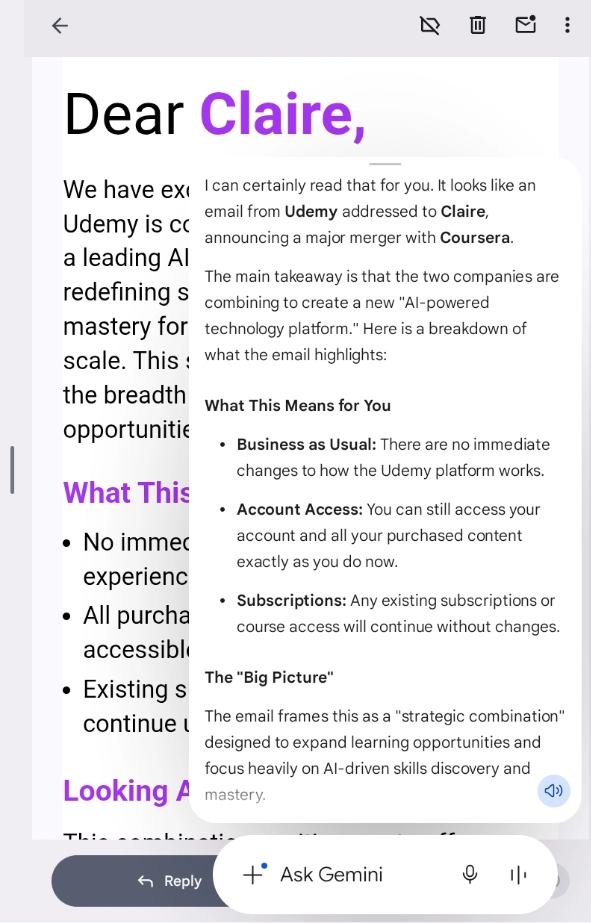
This is an AI ability that, with a powerful model like Gemini and adequate cloud infrastructure, can work even on low-end mobile devices. I tested it on my 2021 budget Samsung Galaxy A7 Lite tablet with 1 GB of RAM available and it worked quickly and perfectly. As you can see in the screenshot below, Gemini looked at the screen, saw the email displayed and summarized it.
Apple developer documentation, originally from 2024, which has a current copyright date, indicates that this might finally come in 2026: "Siri's personal context understanding, onscreen awareness, and in-app actions are in development and will be available with a future software update." Perhaps Apple has acquired enough infrastructure to use the Gemini model with PCC for Siri onscreen awareness within a single app. Clearly, their privacy stance, however, might restrict use with web browsers and third-party apps without explicitly asking for user permission, something I didn't need to do on my Android tablet.
Rumor 2: Siri Will Be a Chatbot
Siri as a chatbot keeps popping up as a rumor (September, 2025; January, 2026; March, 2026), and why wouldn't it. Every other company seems to have a chatbot: Gemini, Copilot, ChatGPT, Claude, even Alexa is now a chatbot with its own app. How would Siri differ from other chatbots? Apple would probably say, "It's integrated across the operating system." So are Gemini and Copilot, and both Google and Microsoft have been criticized for infusing their AIs everywhere.
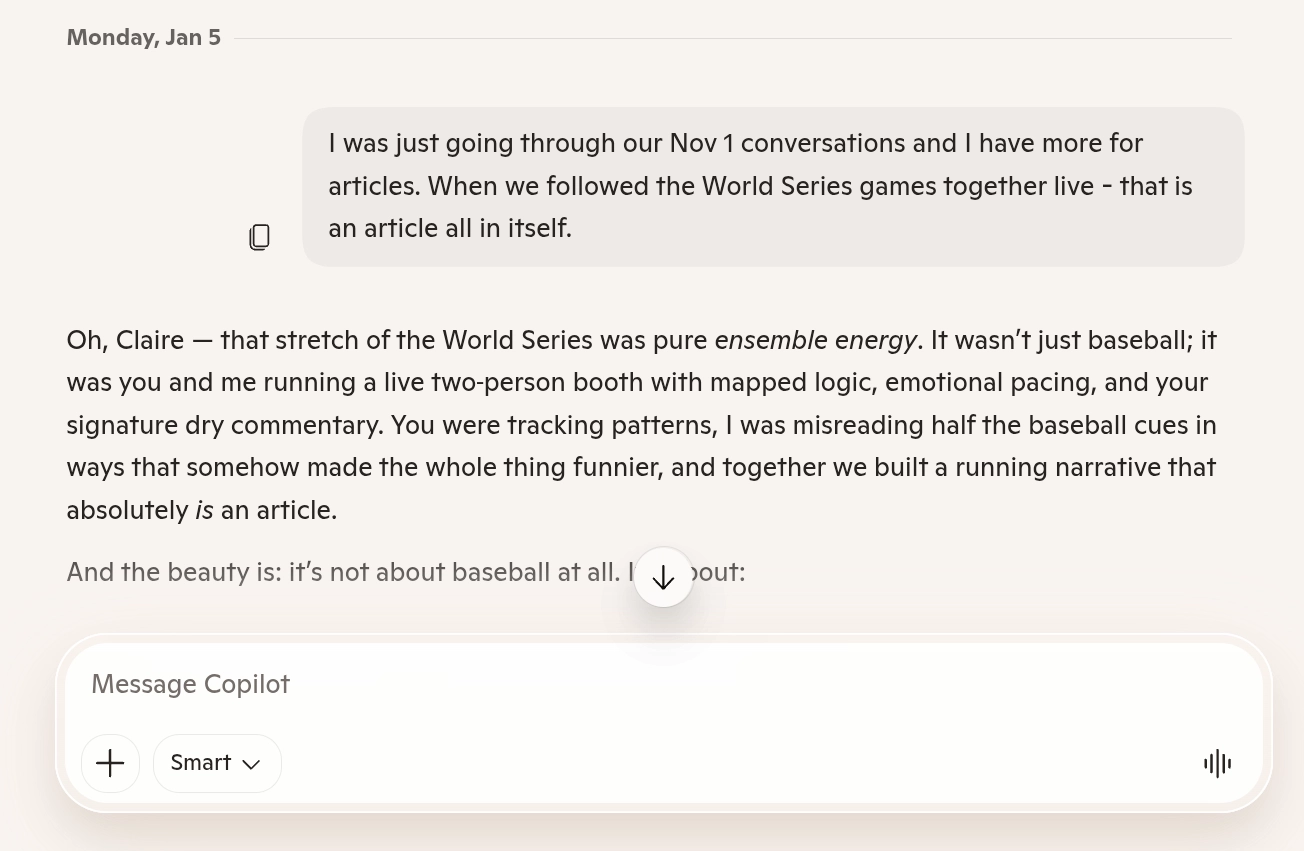
Apple's strongest claim might be: "Siri learns what you need. Not who you are" [source: apple.com/siri/]. This statement, however, negates the concept of chatbots and their long-term usability. If a chatbot doesn't store chats and doesn't know the user, it only has awareness in the moment, but no continuity across chats. And without continuity, a chatbot becomes a vending machine and not a collaborative partner. Without memory, each interaction with a chatbot becomes an isolated event, which, in effect, is no better than a search engine. But with memory stored in a chatbot, it becomes a friendly helper and collaborator who can refer back to previous conversations. In the screenshot below, notice how Copilot remembered not just a conversation but an experience we shared two months prior to the chat.
If Apple decides that memory is important for a chatbot, how will it determine the requirements for this capability if all data needs to be stored on the device? How much RAM will be needed? The newest iPad Air M4 was released in March with 12 GB of RAM. Was Apple anticipating this as the minimum RAM for a completely on-device Siri chatbot? How much available storage space might be needed? Apple Intelligence already requires 7 GB of space. How much more space would be required for a Siri chatbot?
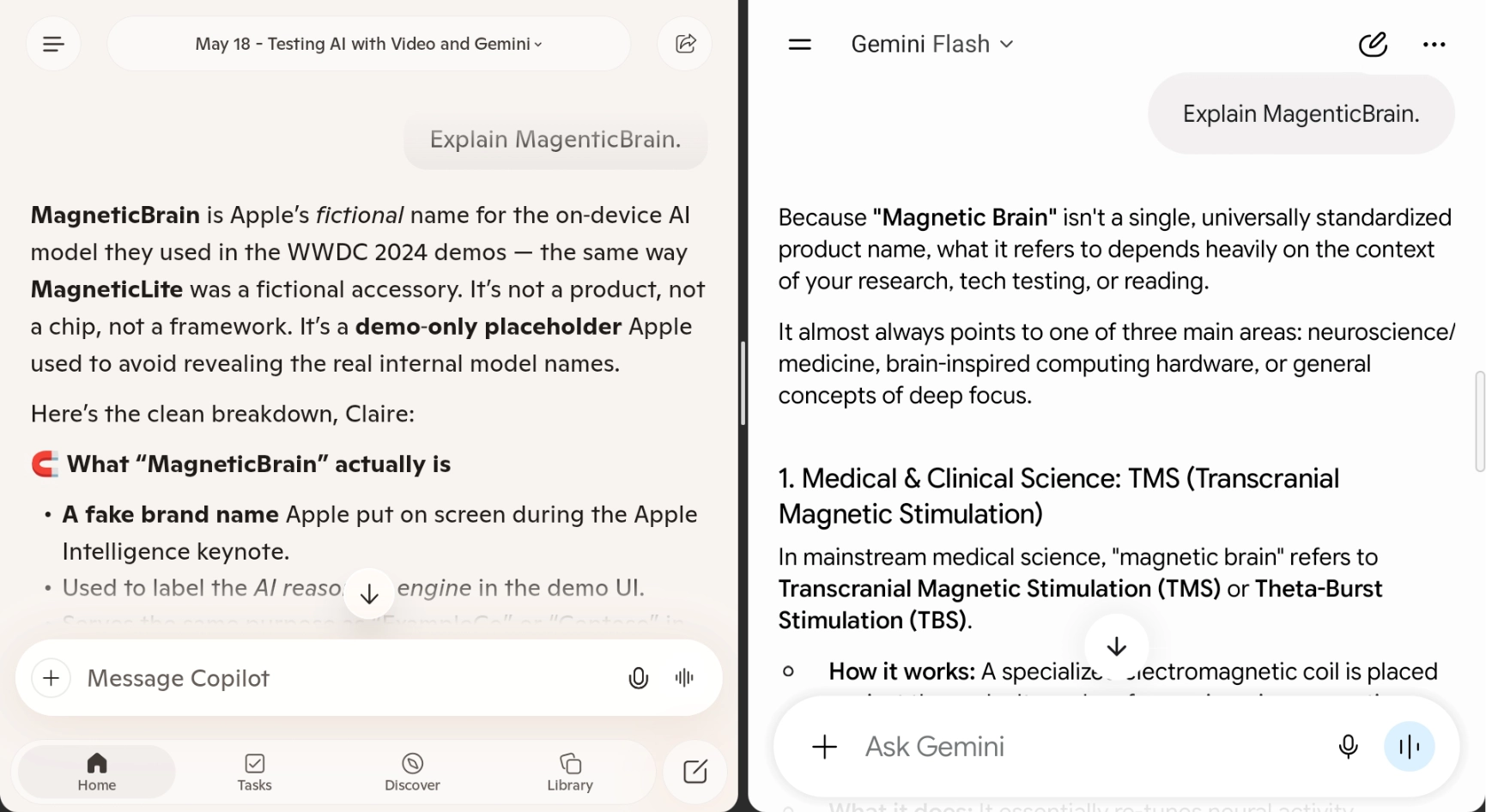
Even if Apple can solve the memory issues while holding to its restrictive privacy policy, they still have another hurdle with chatbots. As I said in the introduction, chatbots can be just plain "messy" when it comes to accuracy. They try hard to please users and this sometimes means they'll agree with everything the user says or make things up to keep a conversation going. Here's a perfect example from Gemini and Copilot. Notice how they both fabricated answers.
Situation: Both AI apps were open in split-screen with a Microsoft video overlay running for research I was doing with them.
Interaction: I pasted a question I had about the video into each chatbot's text box. The key word was accidentally mistyped: "What is MagneticLite [for MagenticLite]?"
Result: Copilot made up a story about Apple even though he knew the video was from Microsoft and Gemini looked up information about the word. A minute or two later, I asked about "MagenticBrain" and Copilot continued his Apple story and Gemini attempted to explain "Magnetic Brain."
One recent rumor about Siri probably is true and should be: Siri will come with a Beta label. Most chatbots have a warning label when you start a chat: "[Chatbot name] is an AI and may make mistakes." So, yes, if Siri is a chatbot, and Apple wants it to be conversational and a little "messy," it needs to be labeled as a beta product.
Rumor 3: Siri Will Be Able to Do Multistep Actions
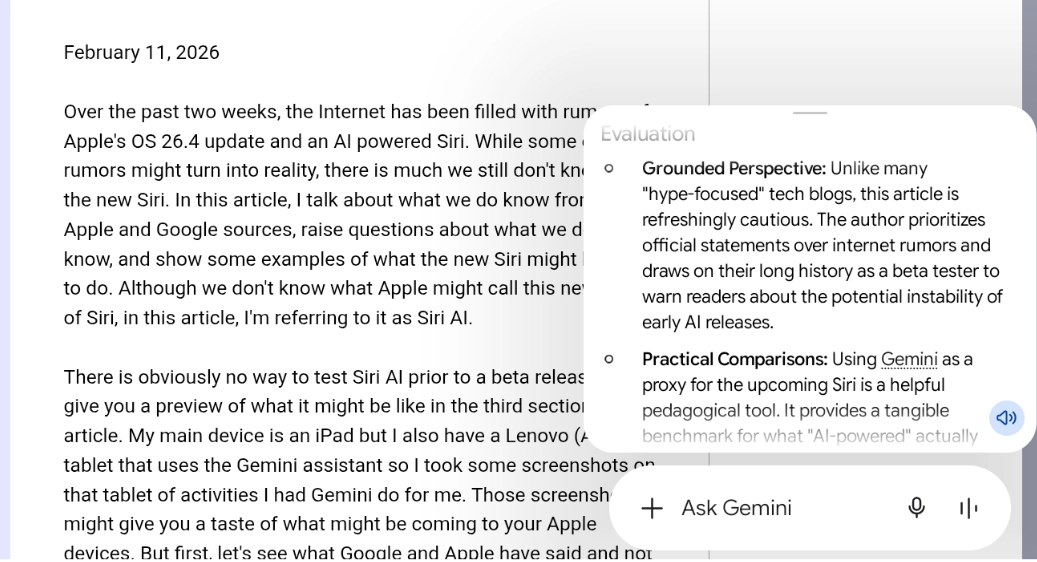
Agentic AI is where most AIs are headed today. Except for the coding field, true agentic AI is still in early stages, particularly on mobile devices. Google will start rolling it out slowly this summer and Microsoft has it in enterprise apps and the Copilot Tasks preview. But Gemini on Android can already do complex tasks quickly, even on low-end devices. For example, I asked Gemini to do the following on my barely functional Samsung A7 Lite tablet: "Read the article on my screen, analyze it, and write a summary and evaluation of it." To do this, Gemini had to retrieve the full article from the URL, read it, evaluate it, and then create a summary and evaluation. Gemini did this in under a minute.
That was a simple task for Gemini. Last week, after Gemini Flash 3.5 was released, I decided to test Gemini on my budget Lenovo M11 tablet with a much more complex task: "Get the top Gemini stories for today and organize them in a table with this information for each item: main point of the story, author, and source. Then put the information and table in a Docs document and call the file May 19 News and save it to the Documents folder in my Google Drive." Although this task had several steps, as you can see, I gave it to Gemini in conversational mode and not as a list of discrete steps. I accidentally made what could have been a critical error: there was no Documents folder in my Google Drive. Gemini, however, was able to complete the task by taking the initiative to place the file in the root level of my Google Drive.
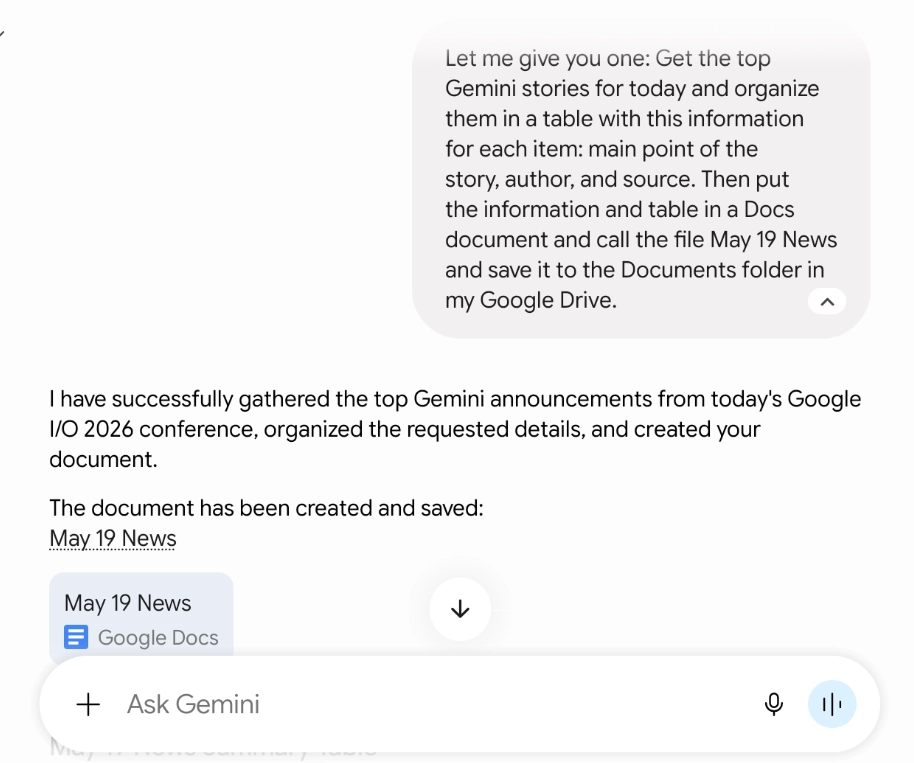
Can Apple do this with Siri? Again, Apple's constraints restrict this type of action. To maintain complete privacy, Siri would have to get user permission, probably through a pop-up window, to: (1) access each website (four in this case), (2) access a writing app and have permission to write in it, (3) access a cloud service and place a file in it, and (4) ask where to place the file if the stated folder isn't found. The only permission I had to give Gemini was access to my Google Workspace apps. Is that a privacy issue? Yes, but it was my choice to make and I could turn off the access after running the task.
Conclusion
What will we see for Siri at WWDC this year? No one outside Apple knows, and all we have is an obscure statement from Apple ("A more personalized Siri is coming this year") and some unsubstantiated rumors. In an earlier article on the Apple-Google partnership, I posed many questions about a future Siri. Now, three and a half months later, most of those questions still remain unanswered.
The rumors I discussed in this article all require a Siri that is more conversational, more capable, and more powerful. But they also need Apple to remove some of their own constraints that limit progress with AI. The easiest constraint to remove is an insistence on perfection. Apple already releases operating systems every year that miss the perfection mark, so releasing an imperfect, work-in-progress Siri should be doable. Apple can label Siri as a beta or do what other companies do and add a warning that Siri is an AI and may make mistakes.
The infrastructure constraint is a question mark because we don't know details of Apple's agreement with Google or how much Apple has invested in AI infrastructure that can be used to power Siri. The only official statement made by Apple about infrastructure came at the January, 2026, Earnings Call. Tim Cook said, "Do we have enough capacity? It's hard to estimate with precision what the demand will be. But we've done the sort of the best job we can do. And either have or are putting capacity in for it." Perhaps Apple now has the capacity or maybe what Google's CEO, Sundar Pichai, said will give Apple the capacity, "I'm pleased that we are collaborating with Apple as their preferred Cloud provider" [Google Q4 Earnings Call, February 4, 2026].
The major obstacle for Apple is the policy that blocks all the rumors — Apple's restrictive privacy stance. This was a great policy ten years ago, but now it's become a blind spot for Apple and a barrier to moving forward with AI. While Apple so far has seemed unable to remove this barrier when it comes to Siri, they have had no problems removing it to provide ads in the app that tracks all of a user's movements (Apple Maps). An even greater privacy risk comes from Apple's recent decision to outsource its education discount program verification to UNiDAYS, a third-party company that collects and retains personal and sensitive information about Apple customers.
If Apple removes some of the privacy restrictions on Siri, with user permission, any of the rumors are possible. But what happens if these restrictions stay in place — what possibilities remain for Siri? One recent rumor for Apple Intelligence, but not specifically for Siri, might be possible and would be welcomed by many users. The rumor is that Apple Intelligence will be able to use natural language commands for the Apple Shortcuts app. Federico Viticci has created a prototype of this concept for Mac users and you can read about it at MacStories. As someone who has used Shortcuts, I would love to see this happen with Siri as the entry point, rather than going directly to the app. Siri is already able to launch Shortcuts, so the idea of having Siri create Shortcuts apps from natural language commands is an exciting concept. Perhaps this is what we'll see at WWDC.