Chapter 5: Findings — Important Functions of Literacy for the Children
The children, through their actions, demonstrated that literacy served important functions for them. In some cases, the children learned about these functions of literacy from the adults in the classroom. Cathy, the teacher, provided demonstrations of the functions of literacy when she focused the children’s attention on charts in the room, wrote notes to and read notes from the children’s parents, wrote experience stories with the children, fingerspelled words from their clothing, books, and filmstrips, and read and acted out fairy tales with the children. Cathy, the teacher’s aide, the speech pathologist, and I read to the children. In addition, the children watched me write field notes while they performed routines, played, read, drew, and wrote.
Researchers studying functions of literacy have documented that young children learn about the functions of written language through demonstrations of literacy (Crowell, Kawakami, & Wong, 1986; Dyson, 1986; Freeman & Hatch, 1989; Goodman, 1986; Harste et al., 1984; Smith, 1981; Teale, 1986). For instance, in a study of emergent literacy of kindergarten hearing children, Crowell et al. (1986) found that “Within an environment that provided frequent models of the functional use of reading and writing, as well as ample opportunities to practice literacy behaviors, the children in this kindergarten classroom were readily convinced that reading and writing were important.” (p. 149)
After analyzing the data from the current study for functions literacy served for the children, I found that the functions fell into two categories: functions that served social purposes and functions that served private or personal purposes. In prior studies of hearing preschool children (Neuman & Roskos, 1988) and kindergarten hearing-impaired children (Conway, 1985), the researchers found broad categories of functions that literacy served for the children. Neuman and Roskos defined the categories of functions in their study as exploratory, interactional, and transactional functions. The specific functions within these categories parallel some of the social and personal functions of literacy described in the following sections. For instance, the functions defined as interactional relate to the “social and communicational nature of literacy” (p. 8). These functions are similar to the functions labeled social in this study. Conway (1985) categorized the purposes for literacy demonstrated by the children in his study as message-related and non-message related. These two categories of functions closely parallel the social and personal functions delineated in the following sections.
Social Functions
The children, almost from the start of the school year, discovered that reading, writing, drawing, and fingerspelling could be used to interact socially with their peers and the adults in the room. As the year went on, they discovered more and more social uses for literacy. This finding is consistent with findings from studies on literacy learning of young hearing children. For example, McGee and Richgels (1990) found that Kristen, a preschool child in their study, used picture labeling activities to engage her parents in social interactions during book sharing times. The deaf child in Maxwell’s studies (1983, 1984) exhibited similar behaviors as she interacted with family members. Ewoldt (1987), in a study of preschool hearing-impaired children engaging in writing at a literacy center, also found that social interaction was a critical factor in the children’s developing literacy.
Analysis of the data for the current research revealed five broad social functions literacy served for the children:
1. Literacy events provided opportunities for the children to communicate with each other and with adults.
2. Knowledge and achievements could be demonstrated and shared through literacy.
3. Literacy events provided opportunities for the children to be members of a group.
4. Literacy events provided opportunities for the children to please adults and gain their approval.
5. Enjoyment of literacy could be shared with others.
Communicate with Others
When they did not have the oral or sign language they needed to express themselves, the children turned to written language as a way to communicate with others. Although written language was used as a communication tool for other social functions (e.g., to share knowledge and achievements), there were times when the only function for using written language was as a substitute for the oral and sign language the children lacked. Often, in situations where hearing children might use oral language and gestures, the hearing-impaired children in this study did not have the same options; their choice for expressing themselves was through gestures and written language. In short, written language was the tool for communicating and communicating was the primary reason written language was used. This function is similar to Halliday’s (1975) interactional function of oral language: “language used by the child to interact with those around him” (p. 19).
One purpose the children had for using written language was to create dialogue for the sheer pleasure of engaging in social interaction. From the start of the school year, the children used their knowledge of their printed and fingerspelled names to communicate and interact with each other. Jeffrey, in particular, often used his knowledge of names to interact with Michael, who, in turn, used his knowledge to sustain the interaction.
Excerpt from Field Notes (9/28/89, 10:30 A.M.):
Snack time: Jeffrey pointed to the chalkboard drawing of himself and emphatically signed, “My name.” Michael then pointed to the Share Bag chart and declared, “Me!” This interchange between the boys continued for several minutes as they excitedly pointed to names on charts around the room.
Excerpt from Field Notes (1/26/90, 8:40 A.M.):
This morning during playtime, Michael and Jeffrey had a discussion concerning who would be first on line when the class went out for recess. The two boys repeatedly signed, “Me first” for several minutes. To settle the discussion, they went over to the line-up chart Cathy had posted in the hallway and they looked to see whose name was over the word First.
Excerpt from Field Notes (2/1/90, 10:25 A.M.):
Cathy has a chart over the sink for snack helpers that lists each job (i.e., who gets cups, napkins, snack, or milk) and each day a card with a student's name is placed to the left of each job.
As they washed for snack, both Michael and Jeffrey looked at the chart. While they walked to their seats, Jeffrey asked Michael, “Napkins?” and Michael responded, “Darrell” and then he shook his head “no” to indicate that, although it was Darrell's job to get napkins, Darrell was not in school today.
Over the course of the year, the children used written language more and more as a primary form of communication. Michael, in particular, realized that drawings labeled with words conveyed messages. For example, the following incidents occurred as Michael drew in my notebook.
Excerpt from Field Notes (10/19/89, 8:40 A.M.):
I laid my notebook on the floor and Michael began to draw. He drew a car shape, tapped Jeffrey who was playing nearby with a truck, and signed “car.” Michael then added wheels to his car and drew himself inside the car.
Excerpt from Field Notes (2/8/90, 8:40 A.M.):
Michael took my notebook and pencil and drew a picture of a person. When I asked what he had drawn, Michael signed, “Michael, Grandmother, Grandfather, sad, broken.” He then added writing to his picture—he wrote Mom on the paper.
The other children also used their drawings, often combined with written labels, to communicate messages to others in the room. For example:
Excerpt from Field Notes (1/25/90, 10:20 A.M.):
Darrell took my pencil and drew on the paper in my notebook. When he finished his picture, he signed “milk” and pointed to what looked like a milk carton in his drawing. He began to write and draw again. He signed “swim” and then proceeded to draw what looked like a fish bowl with a fish in it.
Excerpt from Field Notes (12/4/90, 12:35 P.M.):
Janine took some chalk and went to the chalkboard to draw. She drew a large circle and then a figure in the circle which she later told Cathy was Mom. Janine then drew another figure to represent herself. She ended by putting little lines on the outside circle which Cathy interpreted as representing the sun.
Excerpt from Field Notes (3/12/90, 1:07 P.M.):
Janine brought the rocking chair over to me, took my notebook, and announced, in voice, that she was going to draw a house. She drew a window and then a house and then asked me to write numbers (street numbers?). When I didn’t understand what she wanted me to do, Janine went to the calendar and pointed to the numbers and then wrote the numbers one through ten along the side of the house and across the bottom of her picture.
Occasionally, Cathy wrote stories with the children about experiences they shared, such as a trip to the state fair. These charts provided the children with another source of written language to use as a form of communication. The stories were written on large sheets of lined oak-tag paper and kept on a metal chart rack in front of Cathy's desk. The charts were accessible to the children and they pointed to them or to specific words on them to communicate with others. Early in the year, the children merely pointed to names on the charts, but as they developed more knowledge of written language, they found more sophisticated uses for the charts. For example:
Excerpt from Field Notes (11/3/89, 8:35 A.M.):
Jeffrey went to the experience story on Halloween and pointed to the picture of the lion that Cathy had drawn and he signed “lion” and “David” to indicate to me that David had been dressed as a lion for Halloween.
Excerpt from Field Notes (11/21/89, 12:20 P.M.):
Billy pointed to a new experience story about Thanksgiving (from the morning class) and yelled to Janine, “Look!” Janine went to the chart and pointed to a picture of a house with many people next to it and she made a Wow! expression with her face.
The children found that books served as tools through which they could communicate to others. Frequently, when they read books, the children would make speech-like vocalizations, label pictures, or tell a story orally or in sign. Sometimes, two of the children (usually Michael and Jeffrey or Janine and Billy) would sit close to each other and discuss a book as they read it together. Maxwell (1984) also found that using books as a tool for communication was important to the developing literacy of the deaf child in her study. Alice, when retelling a story, would use the pictures in the book to aid in her retelling by locating the pictures she wanted and then making the sign on top of the picture (e.g., in “Goldilocks and the Three Bears,” she signed BREAK on top of the picture of Baby Bear’s broken chair). “The pictures thus had more importance than simply as illustrations of the story. Alice knew the picture she was looking for and what she wanted to say, but she needed to say it on the picture” (p. 202).
The excerpts below help to illustrate how the children in the current study attempted to communicate to others through book reading.
Excerpt from Field Notes (9/15/89, 10:45 A.M.):
Darrell sat on my lap and looked at a book. As he turned pages, he looked at the pictures and made speech-like sounds (sounds similar to those made by someone who is reading, but they were not intelligible).
Excerpt from Field Notes (2/5/90, 2:10 P.M.):
Janine took the copy of “The House that Jack Built” that Eileen and Cathy had constructed and sat next to Billy. As Janine read to Billy, she put her finger under each word and read orally. For words she didn’t know, she made speech sounds that had the correct number of syllables.
Excerpt from Field Notes (3/30/90, 10:40 A.M.):
Jeffrey ran to the book corner and grabbed the rocking chair and a book. Michael took a chair and moved next to Jeffrey. Both sat, side by side, facing the bookshelf and looking at books. Jeffrey kept talking to Michael, signing words, phrases, and sentences for the pictures in his book. For some pictures he pointed to himself and for others to Michael. Michael watched Jeffrey, smiling occasionally and nodding in agreement. Jeffrey finished his book and then took an alphabet book and signed to Michael about the cover of the book. Michael began talking, in sign, with Jeffrey about the picture of a giant. Michael signed “broken” and several other adjectives. Jeffrey got up and Michael called him back by pointing to the picture for the letter M. Jeffrey sat down again and the boys talked about the pictures.
Jeffrey: Witch chop {for picture of giant}.
Jeffrey did most of the signing while Michael communicated more with facial expressions. Occasionally, Jeffrey would get a wow expression on his face and once he even slapped his hands on the sides of his face.
An important aspect of the children’s use of books as a communication tool is that it provided a way for them to instantiate their past histories. Since the children did not have sufficient oral or sign language to communicate past experiences, they sometimes used pictures and words in books for this purpose. For example, in the excerpt below, Michael used a book as more than just a tool for communicating with Cathy; he used the book to talk about a past event that had occurred at his house.
Excerpt from Field Notes (10/12/89, 10:35 A.M.):
Michael took a book and when he looked at the first picture, he looked at Cathy and signed, “Mom, Dad ride motorcycle.”
Demonstrate and Share Knowledge and Achievements
The children seemed to enjoy sharing knowledge with their peers through written language. Literacy events afforded the children opportunities to tell others what they knew; in essence, they were given opportunities to show off their knowledge. This function of sharing knowledge has been documented by other researchers studying literacy development of hearing and hearing-impaired children (Covarrubias, 1988/1989; Ewoldt, 1987; Neuman & Roskos, 1988; Rowe, 1989). Neuman & Roskos have termed this function interactional and it incorporates the previous function discussed (To communicate). It is also closely related to one of Halliday’s (1975) functions of oral language; namely, the informative function of language or the “I’ve got something to tell you” function.
Early in the year, the children would use charts in the room to share their knowledge of written names. Often, they used these charts to let others know that they could recognize printed names.
Excerpt from Field Notes (9/18/89, 12:50 P.M.):
Cathy had a large picture of a school bus in the front of the room. Individual cards (5” x 8”) with the children’s names on them were taped to the bus windows. During group time, while Cathy was drawing a picture of Billy, Janine pointed to her name on the bus chart and then to herself. She then pointed to Billy’s name and looked at him. Several minutes later, she again pointed to her name on the bus chart and showed Cathy. After another couple of minutes, Janine turned to Billy and pointed to her name on the bus chart and then to herself.
Billy: {as Janine pointed to names on the chart} My name. That’s Jon.
The children also shared knowledge through written language when they engaged in book reading. They often labeled pictures for the adults in the room or shared stories with both adults and peers by reading books to them. The following excerpts from observations of Billy and Janine are typical of this type of interaction, especially for the oral children:
Excerpt from Field Notes (9/12/89, 2:35 P.M.):
It was book time and Billy sat next to me near the bookshelf.
Claire: Do you want to read the book to me?
Billy: Yeh! {pointing to a picture on the inside cover of the book} Pig.
Claire: Yes, that’s a pig.
Billy: Alligator.
Billy was reading an alphabet book and he turned to the page for the letter D [dragon].
Billy: He has fire in his mouth.
Excerpt from Field Notes (1/16/90, 1:50 P.M.):
Janine took two books about eggs and pointed to the words on the covers of the books (egg) and noted that they were the same. Later, before going to recess, Janine took the two books to Cathy and pointed out the pictures of the eggs and then the word egg on both covers to indicate that they said the same thing.
A less direct way the children shared knowledge was through demonstrations of literate behaviors. The children carefully observed each other when reading books and experience stories and during drawing and writing activities. Their own reading and writing, in turn, reflected the knowledge gained from these observations. Again, findings from research by Rowe (1989) with hearing children and Ewoldt (1985) with hearing-impaired children lend support to the findings from the current study. The children in Ewoldt’s and Rowe’s studies, like the children in the current study, were intensely interested in their peers’ drawing and writing and they used the knowledge they gained from observing their peers in their own work. In the current study, the children’s reading behaviors as well as drawing and writing work were noted as contributing to the developing literacy of their peers.
Excerpt from Field Notes (1/23/90, 2:10 P.M.):
Janine brought a book to me and started reading. She pointed to words and pictures in the book and read in a lyric, singsong fashion, creating her own words. Billy came by and laughed at Janine, and I told him that Janine was reading in her own way.
Several days later (1/30/90), Billy sat and read a book to himself, making unintelligible speech-like syllables that sounded like a person reading or telling a story. His book reading behavior on this occasion was almost identical to Janine's on January 23rd.
The children's writing samples often displayed the knowledge they gained from watching each other. Sometimes the learning was the result of the children watching the work of their peers, while at other times it was due to direct teaching by one child.
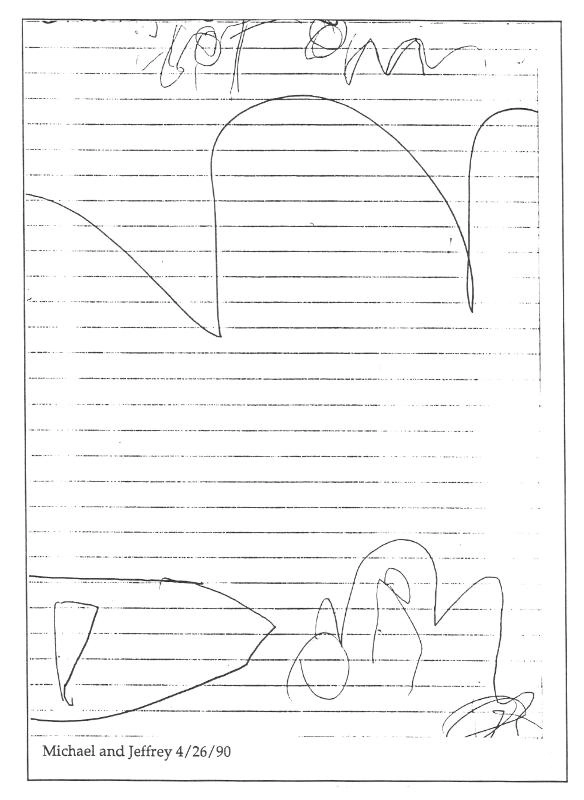
Excerpt from Field Notes (4/26/90, 10:50 A.M.):
Michael took my notebook and pencil and sat down and drew a picture of a mountain.
{It looked like it started out as a house and turned into a mountain when Jeffrey, who is going camping this weekend, joined us.}
Jeffrey took the pencil, signed M near his face and then signed, “Mountain.” He wrote M and started to draw a picture of a mountain. Michael tried to help (correct?) Jeffrey by reaching for the pencil and vocalizing. I told Michael to let Jeffrey finish by himself. Jeffrey completed his picture and then wrote his name on the top of the paper. Michael took the pencil and wrote a J going in the right direction (Jeffrey’s goes in the wrong direction) and then traced over the letters Jeffrey had written.
Excerpt from Field Notes (1/30/90, 2:10 P.M.):
Janine has been writing for several months and she is quite confident in her abilities and knowledge. Her writing contains letters and letter-like forms and usually resembles adult messages.
Billy, on the other hand, can write his name, but rarely writes anything else. Today, however, he wanted to draw and write in my notebook. He made random lines on the paper, smiling and laughing as he did it. He did not seem to have any plan in mind, he just seemed to be enjoying exploring the use of the pencil. Janine, through her actions, indicated that Billy needed a lesson in writing, so she took the pencil from Billy and repeatedly told him to “Watch” as she wrote. She showed him the correct way to write and draw by first writing some letters from her name and then drawing lines on the paper. Before giving Billy the pencil, Janine erased her letters, and seemed to be telling Billy, “Write your name and then draw something.”
The children frequently shared their literacy achievements as well as their literacy knowledge. When they learned something new about written language they made certain others in the room were aware of their accomplishments. For example, as Janine developed some proficiency in writing, especially names, she shared this knowledge and achievement with her peers.
Excerpt from Field Notes (1/30/90, 2:00 P.M.):
Janine decided to write during book time. She first wrote some letters [q, o, b] and told me it said Dad. Next she wrote her name, then Jon’s name, and then Billy’s name, looking at the chalkboard in the back of the room to make the Y. Jon walked past Janine during this activity and she tried to show him that she had written his name by loudly calling his name three times and exclaiming, “Look!” as she pointed to her writing.
When he learned how to spell his name, Jon, like Janine, was eager to share his achievement with his peers and teachers.
Excerpt from Field Notes (1/23/90, 12:45 P.M.):
Jon spelled his name, pausing after each letter as Cathy, his teacher, wrote his name on the Happy Faces chart. When Cathy then asked Janine to spell her name, Jon loudly announced, to anyone listening, “I can spell my name.”
After making the connection between printed names and the people they represented, David wanted to share his literacy achievement with anyone who would listen.
Excerpt from Field Notes (9/28/89, 8:50 A.M.):
Cathy wrote Jeffrey’s name on the chalkboard. David pointed to Jeffrey’s name on the Share Bag chart and then tapped Jeffrey. David then went up to the chalkboard, pointed excitedly to Jeffrey’s name and signed “Jeffrey” while trying to share his new found knowledge with Cathy and his peers.
In the excerpts below, note the efforts the children made to inform their peers or adults in the room of their literacy achievements.
Excerpt from Field Notes (11/2/89, 8:25 A.M.):
Michael had a paper (from his regular nursery school?) with him today on which he had written his name. Someone had written his name on the top of a lined sheet of primary-ruled paper and he had written his name underneath. He brought it over to me when he first came in and pointed to my pencil as he showed me his work.
Excerpt from Field Notes (11/3/89, 8:30 A.M.):
Michael again had the sheet (from yesterday) with his name on it with him today. He took it out of his backpack as soon as he entered the room and showed it to me. After I acknowledged it, Michael put it back in his backpack.
Excerpt from Field Notes (2/12/90, 1:30 P.M.):
The children were making Valentine’s cards for their mothers. Janine wrote Mom on the back of her card after drawing a picture of a person on the front. She tapped Cathy twice to get her attention and then pointed to her writing of the word Mom.
Excerpt from Field Notes (1/23/90, 1 P.M.):
Jon took a puzzle with alphabet pieces for play time. This is one of Jon's favorite activities—he takes it almost every day and he has gotten progressively better at fitting the letters into the correct slots in the puzzle board. He enjoys learning the letter names and discovering where each piece fits, often asking others “Where this go?” as he works the puzzle.
Today, Jon had a very serious look on his face [his mouth was open and his eyebrows were furrowed] as he took out the pieces. He looked at the pieces and tried to fit them in but he kept mixing up several letters. Finally, Jon completed the puzzle and proudly announced to his friends in a booming voice, “Look what I do guys!”
Members of a Group
When one child started writing, suddenly two or three others would join in the activity. If the teacher, Cathy, the teacher's aide, Eileen, or I read a book to one child, others would pull up chairs to take part in the book sharing. Stories, especially fairy tales and folk tales, were often a strong force for social interaction.
Excerpt from Field Notes (11/9/89, 9:30 A.M.):
Cathy, the teacher, got out three bowls, three chairs, three stuffed bears, and three rug squares [for beds] so the children could act out the story of “Goldilocks and the Three Bears.” Jeffrey immediately asked to be Goldilocks. When Cathy asked who wanted to be Mama Bear, Michael volunteered. Jerry (another child in the class, not included in the study) then volunteered to be Papa Bear and Cathy assigned the part of Baby Bear to David. Cathy then gave each of the bears a stuffed bear to hold as the children acted out the story. Throughout this activity, Darrell tried to become part of the group by moving nearer to the other children and by trying to grab one of the bears.
Although Darrell had not volunteered initially to play one of the parts (in fact, he seemed uninterested at first), once the activity began and the children started acting out the story, he wanted to get involved and be a part of the acting troupe. By the end of the activity, Darrell was noticeably upset, watching the others with tears in his eyes, longing to be a part of the group.
Occasionally, when an adult read with one of the children, others would try to become involved in the book sharing experience.
Excerpt from Field Notes (1/30/90, 1:50 P.M.):
Billy made it clear to me that he did not want to read with me—he turned his back to me and told me “No.” However, as soon as Janine brought a book over and pulled up a chair next to mine, Billy moved his chair right behind mine. While Janine and I read, Billy read to himself, but very loudly. Since Janine and I were engrossed in our reading, we ignored Billy. This did not deter Billy from his attempts to gain our attention. He walked in front of us and pushed his book in Janine's face and said, “Look at this, Janine.”
Although Billy did not want to read with Janine and me, he did not want to be excluded from our group.
Involvement in book sharing events seems to be of importance to both hearing and hearing-impaired preschool children. In several studies, researchers have noted the efforts young children make to be members of book reading events. Crowell et al. cited this example from their study:
Students clustered in groups, reading and talking about books that the teacher had read aloud to the class. Often a group of two or three huddled around a book that they had heard and jointly told the story by recounting catchy phrases or recognizing them in print. (Crowell et al., 1986, p. 148)
Writing occurred most frequently in the two classes when one of the children took possession of my notebook and started writing in it. Within seconds, other children surrounded the writer and watched intently what he or she did as they awaited their turns.
Excerpt from Field Notes (12/14/89, 10:25 A.M.):
David and I were sitting on the floor looking at a book when Jeffrey came by and took my pencil. He wrote his name and then I told him to write, “Jeffrey is here,” which he did. David then wanted a turn and he drew some random lines and then wrote Jeffrey's name.
Michael joined the group and drew a picture of a friend of his. Jeffrey next drew a picture of two people and wrote his name under one. When I asked who the other person was, Jeffrey signed, “My friend, David.”
Throughout this activity, which lasted fifteen minutes, the three boys sat close together on the floor, heads almost touching, watching what each writer was doing on his turn. Being friends and a part of this activity was expressed in the boys' drawings and writings as well as in their physical closeness.
There were times when the children tried to involve their peers in literacy events. In the excerpt below, note the efforts Darrell made to involve Jeffrey and Michael in the writing group.
Excerpt from Field Notes (2/15/90, 10:30 A.M.):
David wanted to write so I laid my notebook on the floor. Darrell quickly finished snack and joined us. He then signaled “Come” to Jeffrey and Michael who were sitting in the book corner reading. They, however, were totally engrossed in their books and ignored Darrell. David then signed “Come” while looking at Jeffrey and Michael who continued to read. Darrell, determined to make this a whole group activity, went over to Michael and tapped him and told him to come join the writing group. When he finally realized that his efforts to involve Michael and Jeffrey were futile, Darrell rejoined David and the two boys continued their writing, taking turns and sharing their work with each other.
The excerpt below describes an incident when coercion was used by Janine and Billy to involve Jon in a group literacy event.
Excerpt from Field Notes (5/15/90, 1:05 P.M.):
It was playtime. Jon went to the bookshelf and, after looking over several books on the shelf, chose one and went to the table in the back of the room to read by himself.
Janine, during this time, moved the chairs from the side of the room and set up a reading circle in the center of the room. Billy helped Janine move chairs and then went to the bookshelf, looked at some of the books, and chose four or five to place on one of the chairs. Janine and Billy sat down and started looking at books. Jon glanced up from his reading to watch Janine and Billy. Noting the fun they seemed to be having, Jon took his book and joined them. After a minute or two, however, Jon decided to leave. He took his book to the table to read by himself again. As Jon started to walk away, Billy grabbed Jon’s book and put it on the book chair in the reading circle.
Jon: That my book.
Billy: You want it, you have to sit down.
Jon: {After taking another book from the shelf and walking towards the table}
So I got this one!
Janine pushed Jon’s chair away from the reading circle. When Jon noticed this, he returned with his book to the reading group.
There was one literacy event that occurred several times during the morning class in which the children did not want to cooperate with each other and be part of the group. When Cathy allowed the children to write on the portable chalkboard, they would fight over their space on the board and interact only in negative ways; they would be very possessive of their own space and work and would push, shove, or hit anyone who interfered with them.
Excerpt from Field Notes (4/27/90, 8:30 A.M.):
David asked Cathy for the chalkboard during playtime. When Michael saw David at the chalkboard, he went over to join him. Jeffrey, who was playing by himself in the kitchen, tried to get Michael’s attention by pretending to pour something from a coffee cup on him. Michael ignored Jeffrey, and, after a few minutes, Jeffrey joined Michael and David. Within seconds, they were fighting over space on the chalkboard and Cathy had to draw lines on the board to indicate which area was for Jeffrey, David, or Michael.
An almost identical incident occurred the day before with David, Michael, and Darrell fighting over chalkboard space.
Excerpt from Field Notes (4/26/90, 9:10 A.M.):
Michael, Jeffrey, and David were drawing and writing on the chalkboard when Darrell returned from breakfast. He immediately joined them, and Jeffrey, realizing he had now lost some space on the chalkboard, went to the kitchen to play.
After just a minute or two, Michael cried and then hit Darrell when Darrell erased part of Michael’s picture. Darrell then wrote on David’s section, and David retaliated by erasing Darrell’s work. This interchange was repeated several times until Darrell decided to settle the problem by telling Cathy.
Please Adults and Gain Approval
The children often engaged in literacy events to please the adults in the room. They would comply with adults’ requests to label pictures, to draw or write specific pictures or words, and to answer questions about books or stories. The excerpts below help to illustrate how willing the children were to read, write, or draw just to please adults.
Excerpt from Field Notes (11/13/89, 1:00 P.M.):
I called Janine over and asked her to write in my notebook. She was reluctant at first, but when I held out my pencil and encouraged her, she wrote strings of symbols from left to right.
Excerpt from Field Notes (11/17/89, 9:15 A.M.):
I called Jeffrey over and asked him to draw a picture of his doll. He willingly did as I asked and then labeled the picture of his doll.
Excerpt from Field Notes (1/29/90, 1:00 P.M.):
Jon took a book about playtime and asked Cathy to read it to him. Cathy started reading and then asked Jon questions about the pictures (e.g., “What do you like to do?”). Cathy quickly turned this literacy event into an assessment as she asked more direct questions: “Where is the boy going?” “Show me the boy that is jumping.” Although Jon had initiated the activity as a book sharing event, he was very cooperative and willing to please Cathy and do the assessment.
The children were not always this cooperative or willing to let adults control literacy events, especially book reading. Sometimes, when adults intervened in their pleasure of books, the children would try to turn the pages in the books ahead of the adult, take the books to a table, or be very direct about their feelings and turn their backs on the adult.
Excerpt from Field Notes (2/6/90, 2:00 P.M.):
Billy was reading by himself a signed version of “The Gingerbread Man.” Janine went and joined Billy. Eileen, the aide, wanted Janine to read with her, but Janine preferred sharing her book with Billy. She gave him her book (“The House that Jack Built”) and took his book. She then took “The Gingerbread Man” to the table and Billy and Eileen joined her. As Eileen read to the children, she asked them to point to parts of the pictures (e.g., “Where's his eye?”). Janine got impatient and wanted to turn the pages before Eileen was ready. Billy, too, started to turn the pages ahead of Eileen. Janine, at this point, lost interest in the story and seemed to be more interested in turning the pages and finishing the book. When Eileen finished reading, Janine took the book to the other table and read it by herself.
Share Enjoyment
The children took pleasure in reading and they often wanted to share this enjoyment with others. Each child seemed to have favorite books and sharing these books with their friends added to the pleasure of reading. In other studies of literacy development of hearing and hearing-impaired children, sharing the enjoyment of reading and writing was important to the children (Conway, 1985; Crowell et al., 1986; Maxwell, 1983, 1984; Rogers, 1989).
Jeffrey loved fairy tales and he often tried to share these books with his peers.
Excerpt from Field Notes (1/19/90, 10:20 A.M.):
Jeffrey: (to me, in sign) Bears book.
Jeffrey took two copies of “Goldilocks and the Three Bears” (one a sign print book and the other a Golden book). He gave Darrell the sign print book and sat next to him on the pillow on the floor. It looked as if Jeffrey was getting ready to read to Darrell.
Excerpt from Field Notes (4/6/90, 9:05 A.M.):
Jeffrey went to the bookshelf and asked Cathy for “Little Red Riding Hood.” Cathy gave him a book of the story with large, colorful pictures. Jeffrey sat and read for a few minutes and then David came and joined him in the book corner. Jeffrey went to the bathroom with his book and when he came out, he gave the copy of “Little Red Riding Hood” to David.
In the excerpt below, note the joy Jon felt when he shared the ending of “The Gingerbread Man” with me:
Excerpt from Field Notes (4/24/90, 1:10 P.M.):
Jon took a copy of “The Gingerbread Man” over to Eileen and read it to her. When he finished, he came over to me and said, “The fox ate the Gingerbread Man and it was delicious!!!”
Each of the children, at times, enjoyed reading to and with others. They would sit close together or on an adult’s lap and talk or laugh as they read.
Excerpt from Field Notes (4/30/90, 2:50 P.M.):
Janine brought a book over to me and Billy immediately joined us. Both of the children were practically on top of me, reading excitedly.
Excerpt from Field Notes (5/22/90, 2:45 P.M.):
Billy and Janine were sitting in chairs next to each other, reading, laughing, and sharing books with each other and with Jon.
Billy: (as he pointed to a book he was enjoying) Jon, you wanna read this one?
Excerpt from Field Notes (2/8/90, 10:30 A.M.):
Michael read “The Three Billy Goats Gruff” to me as he sat on Eileen’s lap. He turned the book toward me and showed me the pictures while he read, “Goat . . . Big, push.”
Excerpt from Field Notes (4/6/90, 10:30 A.M.):
Jeffrey took “Little Red Riding Hood” (his favorite book) and turned his chair toward me. I moved closer as Jeffrey began to read to me. He read Riding Hood on the title page and then proceeded to tell me the story as he turned the pages in the book.
Sometimes it seemed as if the physical closeness with an adult was the goal of the literacy event. The children, like most children of this age, enjoyed attention and tender loving care from adults and book reading provided opportunities for this type of relationship to occur.
Excerpt from Field Notes (3/27/90, 1:05 P.M.):
Jon took a book (”Horseback Riding”) over to Eileen. She put her arms around Jon and told a story as she pointed to the pictures. When she finished the book, Jon took it to the bookshelf and dropped it on the floor. He pulled another book randomly from the shelf and took it to Eileen. He again stood in front of Eileen with her arms around him as she read the second book.
Excerpt from Field Notes (2/27/90, 1:55 P.M.):
Janine went over to the book corner and dropped down on Cathy who was sitting on the pillow on the floor. Janine pushed Cathy part way off the pillow and sat very close to her. She leaned her head on Cathy’s shoulder and talked to her as Cathy read. Janine pointed out pictures and words in the book, sitting very close to Cathy with her hand on Cathy’s arm.
Personal Functions
There were times when literacy events were private activities and served functions of a more individual or personal nature. Analysis of the data revealed five broad personal functions of literacy events for the children:
1. The children engaged in literacy events to construct meaning for themselves.
2. The children could gain information through engagement in literacy events.
3. Literacy events provided opportunities for the children to make statements about themselves.
4. Literacy events provided a source of personal and private enjoyment for the children.
5. Literacy events provided opportunities for the children to learn about written language.
Construct Meaning
It appears from analysis of the data that the children often used literacy, particularly reading, as a way to construct meaning for themselves. They seemed to be aware that written language conveys messages and they spent long periods of time trying to make sense of those messages. For example, the children would study book covers, pages in books, pictures, sign print, and print for extended amounts of time until they seemed to grasp the intended message.
Excerpt from Field Notes (1/11/90, 9:10 A.M.):
Cathy wrote Darrell is here on the chalkboard and Michael asked to read the sentence. He read Darrell is and then hesitated on here and appeared to be thinking what the word was before signing it.
Excerpt from Field Notes (2/12/90, 9:15 A.M.):
The children were getting ready to make Valentine’s cards. Cathy gave each child a card made from construction paper with a message written inside. David, Jeffrey, and Michael opened the cards right away and looked at the writing. Michael spent about half a minute studying the writing.
The children, when they were intent on gaining meaning from the books they were reading, would be certain to read each page in their books. If they missed a page or two, they would backtrack to read the skipped pages.
Excerpt from Field Notes (9/14/89, 10:20 A.M.):
Jeffrey sat in a chair in the book corner. He took a book and looked at the pictures in the book silently. He looked at each page for about ten seconds. If he turned two pages instead of one, he backtracked and made sure he looked at each page.
Excerpt from Field Notes (10/12/89, 10:40 A.M.):
Darrell took a book cover that was missing pages. He looked at it and seemed to be wondering what happened to the rest of the book. I found the rest of it for him and placed it inside the cover. Darrell then looked at another book and when he missed a page because he had turned two pages at a time, he went back to the page he had missed.
Later, Darrell took a book about a family going to the beach. He looked at the pictures in the book and, again, when he missed pages, he went back over those pages. At one point, after having read the book once, Darrell turned the pages, holding the book at an angle and looking as if he were trying to find a particular page or seeing if he missed any pages.
McGee and Richgels (1990) observed the same behaviors in one-year old Kristen (a hearing child) and Maxwell (1984) noted similar behaviors in Alice (a deaf child):
Kristen would often sit alone, spending many moments looking at her favorite books. She would hold a book right-side-up and turn the pages from front to back. Sometimes she smiled and patted the pictures or turned pages over from one side to the next, intently checking the pictures on each side of the page. (McGee & Richgels, 1990, p. 124)
Alice seemed to go back and forth between the orthography and the sign illustrations and the pictures at almost every word to get the message out. (Maxwell, 1984, p. 210)
Another way the children tried to construct meaning from the books they read was to vocalize or sign as they read.
Excerpt from Field Notes (1/18/90, 10:25 A.M.):
Michael looked at the words at the end of his book. He then looked at the titles of other books listed on the last page. He moved his finger under the words and at some points said, “Yes,” as he shook his head in a “Yes” motion.
Excerpt from Field Notes (2/15/90, 10:30 A.M.):
Michael and Jeffrey were sitting on the floor in the book corner reading. Each read to himself. Jeffrey signed occasionally to himself (mostly labeling pictures in his book) and Michael vocalized and signed to himself as he pointed to pictures in the book.
Excerpt from Field Notes (2/6/90, 1:30 P.M.):
Billy read a sign print version of “The Gingerbread Man” to himself. As he read, he tried to form the signs depicted in the sign print, and he moved his mouth, making barely audible sounds.
The children in the total communication class had an additional way of constructing meaning from written language. When Cathy signed stories or filmstrip captions, the children would sign or fingerspell along with her. Jeffrey was the first of the children to do this, but as the year went on, David and Michael also discovered that this was a viable way to make sense of print and print-related materials.
Excerpt from Field Notes (11/3/89, 10:00 A.M.):
Cathy told the story, in voice and sign, of “Goldilocks and the Three Bears.” As she told the story, she turned the pages in a book she had placed upright on the table in front of the children. Jeffrey imitated Cathy’s signs throughout the telling of the story. At two points during this activity, Cathy asked Jeffrey questions about the story and he was able to give answers that indicated that he was not only imitating the signs, but comprehending them in context as well.
Gain Information
The children seemed to understand that they could gain information by engaging in literacy events. From the start of the year, they realized that the various charts in the room that had their names written on them could be used as reference points for learning how to write names and for determining turns.
Excerpt from Field Notes (2/15/90, 9:15 A.M.):
The children were drawing pictures on white construction paper. Michael finished his picture and decided to write his name on his work. He looked at the Share Bag chart to determine how to write his name and then wrote Michael on his paper.
Excerpt from Field Notes (1/16/90, 2:40 P.M.):
Billy and Janine looked at the chart that listed helpers for snack time. Cathy pointed out to Janine that she (Janine) gets cups today. Later, Cathy asked, “Who gets the napkins?” and Billy, after looking at the snack chart, replied, “I do.”
Excerpt from Field Notes (1/23/90, 2:40 P.M.):
Billy and Janine went to the sink and looked at the snack helper chart as they washed up for snack. A minute or two later, Cathy asked, “Who gets the cups today?” and both Billy and Janine looked up at the chart for the answer.
Excerpt from Field Notes (3/1/90, 10:23 A.M.):
Jeffrey read the snack helper chart and then went to get the milk (it was his job today).
The children also discovered that written language could be used to confirm information. This function for literacy also has been observed in studies of hearing and hearing-impaired children (Maxwell, 1984; Neuman & Roskos, 1988; Rowe, 1989). Note in the excerpts below how the children in the current study used charts in the room to verify information:
Excerpt from Field Notes (11/27/89, 12:50 P.M.):
Jon went to his backpack and put the Share Bag in. He looked at the name tags on the coat hooks and started to walk away. He turned around and looked intently at the name tags and coat hooks and then went over and tapped his backpack before returning to the classroom.
Excerpt from Field Notes (3/6/90, 2:40 P.M.):
Billy: (after looking at the snack helper chart) Janine get the cups. Jon get the milk. I get napkins.
Billy looked at the chart when he saw Janine at the refrigerator with Cathy. He read the chart, word by word, pausing after each word: “Jon get the milk.”
{According to the chart it was Jon’s turn, not Janine’s, to get milk and Billy was aware of this and used the chart to check his information.}
The children in this study, like preschool hearing children in studies by Goodman (1983, 1986), Harste et al. (1984), and others, understood that information could be gained by reading and studying environmental print. Whenever new toy or snack boxes were accessible to the children, they read or studied them, and, in many cases, shared the information they gained with their peers.
Excerpt from Field Notes (11/27/89, 2:15 P.M.):
Billy pointed, rather excitedly, to the advertisement on the raisin package Eileen took out for snack. He pointed the package out to Janine and then to Eileen, as he exclaimed, “Dinosaur…raisin!”
Excerpt from Field Notes (5/18/90, 8:55 A.M.):
Michael, by pointing to the word Nike on his shoes, indicated that they were the same as Cathy’s. David then looked to see if his were the same. Jeffrey assisted David by pointing to the word Reebok on the back of David’s shoe and shaking his head “No.”
When the children encountered written language in new situations, such as field trips, they would ask Cathy or other adults what the print represented. By doing this, the children indicated that they understood the value of written language for gaining information.
Excerpt from Field Notes (12/5/89, 3:00 P.M.):
We were walking to the bus when Billy and Janine noticed the bus duty schedule in Cathy’s hands. Janine pointed to the schedule and Cathy told her, as she pointed to the word Bus, “This says bus.” Billy then pointed to the word Duty and asked, “What does this say?”
Excerpt from Field Notes (2/8/90, 10:05 A.M.):
This morning we took a walk to Fry’s to buy cookies. On the way back, Michael stopped at a chalkboard sign outside a restaurant and asked Cathy what the writing said. As we passed other signs in store windows or on the street, Michael stopped, pointed to the signs, and waited until Cathy told him what the print on them said.
Make Statements About Themselves
Throughout the year, the children used their knowledge of written, spelled, and fingerspelled names to make statements about their uniqueness and individuality. Researchers on early literacy have noted that children often use their written names to achieve what Halliday (1975) has defined as the personal function of oral language: “This is language used to express the child’s own uniqueness; to express his awareness of himself” (p. 20).
In studies of early literacy, researchers have documented that young children often use their written names to make statements about themselves (Beardsley & Marecek-Zeman, 1987; Conway, 1985; Seefeldt, 1984). This finding also held true for the current study. The children strongly identified themselves with their printed names and often let others know this. For example, for days after making the connection between his printed name and himself, David would go over to charts in the room and repeatedly alternate between pointing to his name and to himself until someone took notice. Note the instances in a two-day period of David attempting to let others know who he was:
Excerpt from Field Notes (9/28/89, 9:55 A.M.):
Recess: While waiting for the other children, David pointed to his name on the line-up chart and then looked at me as if to say, “Hey, that says David. That’s me!”
Excerpt from Field Notes (9/29/89, 9:55 A.M.):
Recess: Before going out, David went to the list of names on the line-up chart and showed his friends his name and then proudly pointed to himself.
Excerpt from Field Notes (9/29/89, 10:40 A.M.):
Book time: David went to the list of names on the line-up chart again, looked at me, pointed to his name and once again to himself. This time when I acknowledged him by saying, “Yes, that’s your name,” David’s face lit up.
The children enjoyed drawing self-portraits and these pictures were strong statements of the children’s uniqueness. Michael’s drawings were more sophisticated than those of the other children, but the statement made by him through his drawings was not. The excerpt below helps to describe how important the children’s self-portraits were to their sense of identity.
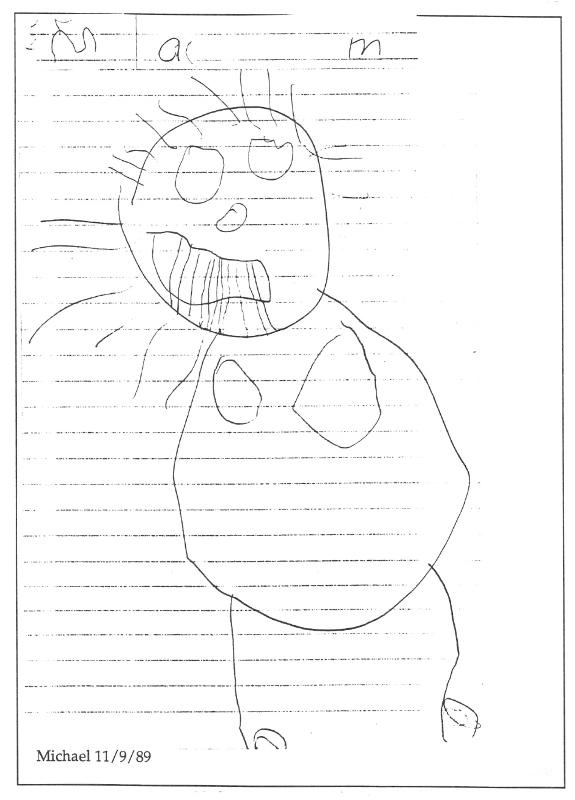
Excerpt from Field Notes (11/9/89, 8:40 A.M.):
Michael took my pencil and notebook and drew a self-portrait. He first drew a circle for his head, then a larger circle for his body. Next he drew stick legs with circular feet. He made two circles on the chest and showed me those were his nipples. Michael made two eyes, a nose, a mouth and many teeth. I told Michael it was time to clean up and he quickly added hair to his drawing, short straight hairs on top with four long strands off the neck {Michael had his back hair in a braid today, but he usually wears the long strands at the back of his head loose}. When I asked who the picture was, Michael signed his name and pointed to himself.
The children strongly identified the initial letters of their first names with themselves. Clay (1975), in a study of early writing, noted the value children placed on their names as representations of their individuality: "Signatures are very personal signs. It is only a rare child that learns any other words before attempting to write some of his own name." (pp. 44)
The following excerpt demonstrates how important this identification was for the children in the current study:
Excerpt from Field Notes (3/28/90, 10:40 A.M.):
Cathy laid a large alphabet chart on the floor and called Darrell over. In seconds all of the children were around the chart and Cathy was getting out plastic letters for the children to match to the letters on the chart.
Michael: (as he pointed to the letter M on the chart, in sign and voice) Me!
The children worked five minutes on this activity until it was time to clean up. David got very upset (he was screaming and forming fists) when Jeffrey tried to put away the plastic D. He settled down only after I gave him the D and he could show everyone that D meant David.
Throughout the year, the children expressed their uniqueness as they wrote their names. They developed their own conventions for writing their names (e.g., Billy always wrote his name BillY and Jeffrey consistently wrote his name with a backwards J) and often made distinctive markings to indicate that their names represented someone special.
Excerpt from Field Notes (11/14/89, 1:35 P.M.):
The children were coloring pictures of the Gingerbread Man. Billy drew a rectangle on the bottom of his paper and announced that he would write his name. He proceeded to write his name inside the rectangle and then colored a section of the rectangle next to his name.
Excerpt from Field Notes (11/27/89, 2:50 P.M.):
Billy had just finished drawing a picture of a house and Cathy told him to write his name on the top of his paper.
Billy: I do like this.
(as he wrote his name in a rectangle he had drawn at the top of his house).
Excerpt from Field Notes (12/5/89, 12:50 P.M.):
Billy was in the kindergarten hearing-impaired class. The children were making snowmen out of styrofoam. After Billy finished his snowman, he wrote his name and put a rectangle around it.
{Billy seems to be establishing a new convention with his name writing—he often boxes it off with a rectangle or a circle.}
As the children became confident in their ability to write their names, they used this knowledge to create a link between their names, their work, and themselves. The following descriptions from observations of Darrell, David, and Jeffrey provide a glimpse into the ways in which the children used their names to make these connections.
Excerpt from Field Notes (3/30/90, 10:20 A.M.):
Darrell completed his artwork and I helped him write his name. He made an x and then another x and two lines (his own marks for his name?). David did the same after Cathy helped him—he wrote his name with her help and then made his own marks above hers.
Excerpt from Field Notes (11/2/89, 9:35 A.M.):
The children were drawing pictures of frightening Halloween sights. Jeffrey drew what looked like a cat. When I asked him what it was, he signed, “Scary.” He then drew a second shape that looked somewhat like a lion. Next, Jeffrey signed his name, exactly as he had written it earlier in the day, but this time he wrote it twice. Jeffrey then painted over his picture except where he had written his name. His teacher, Cathy, wrote his name in the bottom right corner of the paper before sending Jeffrey out to recess with the others. Later, while the children were at recess, Cathy pointed out that Jeffrey had painted over the spot where she [Cathy] had written his name, but the two names he had written were untouched!
Jeffrey seemed to be sending a strong and important message: “This is my work, I am the owner of it, and my name represents me and my work!”
Personal and Private Enjoyment
Literacy events, particularly book reading, often provided personal and private enjoyment for the children. They frequently used book reading as a time to be alone and enjoy books by themselves, secluded from the rest of the class.
Excerpt from Field Notes (9/28/89, 10:40 A.M.):
David took a book and sat in the rocking chair by the book shelf. He looked at the pages in his book intently and quietly. When he finished the book, he looked at the back cover and then put it back on the shelf. Before taking the book from the shelf again, David leaned back in the chair and gently rocked himself for a minute or two, looking very contented and peaceful.
This quiet, self-contented behavior occurred throughout the period of data collection and with each child in his or her own way: Jon would take his private enjoyment at an isolated table, reading to himself; Janine, Michael, and Darrell would sing to themselves as they read; Billy and Jeffrey, like David, would read by themselves, often sitting in the rocking chair and facing the bookshelf.
Excerpt from Field Notes (1/2/90, 1:55 P.M.):
Janine sat in the rocking chair and rocked back and forth and sang as she read.
Excerpt from Field Notes (3/27/90, 2:20 P.M.):
Janine vocalized in her usual singsong fashion as she read a book while lying on the floor. Jon tried to get Janine’s attention and I told him that she was reading.
Jon: (as he put his head close to Janine’s on the floor) Janine, what you reading?
Janine continued to lay on her back reading as the others got ready for recess.
Excerpt from Field Notes (3/26/90, 1:50 P.M.):
Jon took the book “Little Squirt” to a far corner of the table in the front of the room and said, “I gonna read this for me.”
Jon: (in a singsong voice) A policeman. A fire. Brr! Help! The fire! Get on the bike.
Excerpt from Field Notes (2/15/90, 9:00 A.M.):
Jeffrey went to the rocking chair at the start of playtime and took a book to read. He sat by himself, one foot on the bookshelf and one foot on the pillow on the floor. As on other occasions, Jeffrey read by himself, oblivious to everything and everyone else in the room. He finished his book and took a second one. He put one foot over the side of his chair and kept the other one on the pillow. He then took a third book and briefly looked at his friends who were playing noisily with the blocks. Jeffrey then went back to reading his book, moving himself to the floor with his back to the rest of the class. After finishing the book, Jeffrey again looked at the other children, put his book back and joined his friends in the block corner.
Learn About Written Language
The children often took my notebook and pencil to experiment with writing. Sometimes they merely explored the mechanical aspects of manipulating and using a lead pencil, while, at other times, they experimented with different forms of writing (e.g., print or cursive, upper or lower-case). Neuman and Roskos (1988), in their study of preschool hearing children, and Conway (1985), in his study of writing development of kindergarten hearing-impaired children, referred to this function as the exploratory or “How does it work?” function of written language. This function seems to resemble Halliday’s (1975) heuristic or “tell me why” function of oral language.
The excerpts below help to illustrate the different ways the children explored writing and writing tools and the varying levels of complexity of their experimentation.
Excerpt from Field Notes (9/21/89, 10:35 A.M.):
Darrell wanted to see my pencil. He indicated how to make a lead pencil click and I showed him how mine worked. I then gave it to him and he made some marks in my notebook and then returned the pencil to me. Jeffrey watched and I gave him the pencil. He also clicked it and made some marks in my notebook.
Excerpt from Field Notes (11/2/89, 9:20 A.M.):
Darrell came over and wrote with my pencil. He pointed to the eraser on the pencil and I showed him how to use it. He then made a new line on the paper and tried to erase it.
Excerpt from Field Notes (1/26/90, 10:40 A.M.):
David wrote letter-like forms in my notebook. He worked for approximately five minutes, alternating throughout the activity between using my pencil and Cathy’s pen. He seemed to be exploring the use of the two tools and couldn’t decide which he preferred.
Excerpt from Field Notes (11/21/89, 12:55 P.M.):
Janine came over and took my pencil and notebook and wrote two lines of letter-like forms. Billy took the pencil and wrote a few wavy lines. He went off to play and returned in a few minutes to make some wiggly lines all over the paper after stating that he wanted to write some more.
Excerpt from Field Notes (11/9/89, 8:30 A.M.):
Michael came over and took my pencil and started to write letters in my notebook. He made a cursive M and then printed the letters a, r, and m. Next, he pretended to write in cursive—he wrote some squiggly lines while holding the pencil like I do when I write my field notes.
After the children developed some control over writing tools and forms of writing, they began to use literacy events as a way to gain knowledge about the alphabet, words, and, for Janine and Billy, phonemes. The children, from the start of the school year, used terms such as read, write, and draw. Cathy also used these terms and encouraged the children to do so. As the year went on, she introduced activities using the alphabet. She fingerspelled and orally spelled the children’s names from the first day of school and later expanded this to include words printed on the children’s clothing. The children, even the youngest ones, seemed to have some knowledge of the alphabet and they would use books, charts, and their own writing to increase their knowledge.
Excerpt from Field Notes (10/16/89, 2:25 P.M.):
It was book time and Janine took a sign print book. She held it upside down and looked at the signed alphabet, signing 2 for u. I turned the book around and showed Janine the letter f and then pointed to the letter block hanging by the wall. After this, for various letters, Janine would point to the printed letter in the book, sign the letter, and then point to a matching block.
Excerpt from Field Notes (12/8/89, 10:40 A.M.):
David went to the experience chart and wanted me to fingerspell the letters of Michael’s name as he pointed to each letter. He then did the same for the letters in his name.
Excerpt from Field Notes (2/12/90, 2:20 P.M.):
Billy drew a picture of a horse in my notebook. I wrote the word horse for Billy and he copied it, spelling it as he wrote.
Some of the older children had more sophisticated knowledge of written language and they demonstrated this through their writing. For example, Janine, in the following excerpt, showed knowledge of sound-symbol relationships as she wrote the word Mom.
Excerpt from Field Notes (2/13/89, 12:25 P.M.):
Janine sat next to me and started to write in my notebook. She tried to copy my cursive writing of "took." I showed her "took" in print and she copied that. Janine then wrote Mom and read the word to me. She wrote "om" again and read Mom (for Momom) but held the vowel sound longer than normal. Next, she sounded out “mmm”, said the letter o, and sounded out “mmm”. She then said, “one, two” to indicate the two m sounds.
Both Janine and Michael discovered that new words could be learned through recitation. The excerpts below from observations of Janine and Michael demonstrate the advanced and sophisticated knowledge of learning and written language these two children had.
Excerpt from Field Notes (3/9/90, 2:30 P.M.):
On the bus ride home from Rockin’ R ranch I sat next to Janine and Jeffrey. Janine asked me how to spell my name and when I started to fingerspell it, she stopped me after the C. She signed the letter C and then repeated the letter orally several times. She proceeded to do the same with each of the letters in my name and then with the letters in Jeffrey’s name. For each letter, she would sign the letter and say it over orally three or four times in a recitative manner.
Excerpt from Field Notes (4/13/90, 8:55 A.M.):
Michael took my pencil and notebook and wrote some letters that looked like cursive. He then fingerspelled Mom and wrote it. He repeated the fingerspelling several times in much the same way as Janine did her recitation on the bus trip home from Rockin’ R ranch.