Chapter 5: Findings — Decision Making
The children seemed to realize the importance of literacy in their lives and, therefore, engagement in literacy events was not to be taken lightly. Throughout the school year, the children made decisions concerning their involvement in literacy events. In which literacy events would they participate? With whom would they participate? How much involvement would they have in literacy events? How would they participate? These were questions the children constantly faced and made decisions about each day. Specifically, the children made the following types of decisions that affected their literacy learning:
1. The children chose the literacy events in which they would engage.
2. The children made decisions concerning the types of interactions and involvement they would have during literacy events.
3. The children made decisions concerning risk-taking during literacy events.
Choice of Literacy Event
The children had opportunities each day to choose the literacy events in which they wished to engage. Most days each class had two free play periods and a time for free selection of books.
A key decision the children made that indicated the importance literacy had for them was the choice of literacy-related activities over other activities during free play. From September through February, the children chose to engage in literacy events during 25% or more of their free play time. Although the amount of time varied for the children individually, each child, at times, considered literacy events important enough to occupy a substantial amount of their free play period.
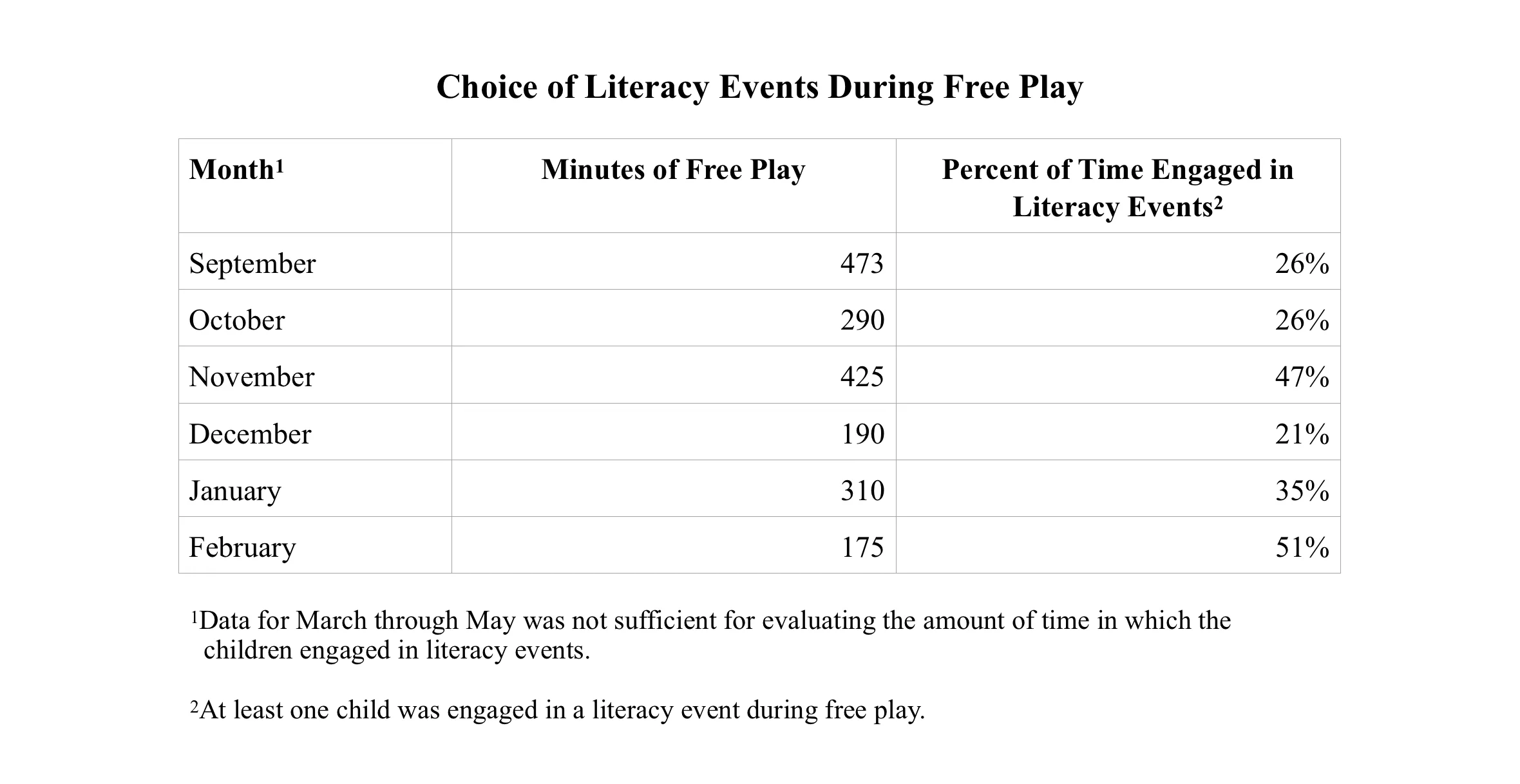
The children’s choices during free play included blocks, toy cars, trucks, and airplanes, kitchen area, puzzles, assorted building toys, gross motor equipment (e.g., rocking horse), and dolls (see Chapter 3, “Site,” for a more complete description). Although literacy events were not specifically offered as choices during free play, Cathy did not discourage the children from choosing them. The children’s most frequent choices of literacy events during free play included reading books and writing in my notebook.
Often, a child’s choice of a literacy event during free play was contagious. One child would take a book or start writing and a second child would join in and, before long, all the children would be sharing in the event. In the excerpts below, note how the decision to engage in literacy events during free play spread from one child to the next.
Excerpt from Field Notes (9/22/89, 9:20 A.M.):
Playtime: Darrell decided to do some writing today. He came up to me and pointed to my pencil, so I gave him the pencil and opened my notebook to a blank sheet of paper. He wrote on a sheet and then David asked for a turn. Next Jeffrey wanted a turn.
Excerpt from Field Notes (11/2/89, 8:30 A.M.):
Playtime: Michael and David were writing with markers. Jeffrey joined them. Soon Darrell joined in the writing activity.
Excerpt from Field Notes (11/21/89, 12:55 P.M.):
Playtime: Janine came over and took my pencil and wrote in her characteristic style in my book. Billy watched and I told him that Janine was writing and he could try after her. When Janine finished, Billy took the pencil and wrote a few wavy lines.
Excerpt from Field Notes (3/8/90, 9:20 A.M.):
Playtime: David wanted to draw on the chalkboard. He drew a self-portrait and wrote his name. Jeffrey and Michael joined David. Each boy took possession of one-third of the chalkboard for drawing and writing.
Excerpt from Field Notes (3/12/90, 12:30 P.M.):
Jon played for eight minutes with a fire truck and then decided to take a book to read. Janine watched Jon and also decided to read during today’s free play time.
Although reading books, drawing, and writing were the children’s most frequent choices of literacy events during free play, those were not their only choices. For example, Jon loved playing with the alphabet puzzle and sometimes he would spend all of his free play time in a day trying to master it. For some of the other children, experience charts were of interest during free play time.
Excerpt from Field Notes (11/3/89, 8:30 A.M.):
David came in the room and immediately went to the experience chart about Halloween. He pointed to it as he made an “Ahhhhh” sound.
A few minutes later, after hanging up his backpack, Jeffrey went to the same experience chart and pointed to the cat picture that represented his Halloween outfit and then pointed to himself.
On some occasions, the children incorporated literacy into their play.
Excerpt from Field Notes (12/4/89, 1:00 P.M.):
Janine was playing in the kitchen, cooking and serving dinner to Cathy and me. She took out the alphabet puzzle and said what sounded like Jon. She put the letters for Jon’s name on Cathy’s plate and put a random assortment of letters on my plate and served us dinner.
The children not only made decisions about which literacy events to engage in, but also concerning the books they read. They were very selective in their choices of books and would openly reject adults’ selections. The excerpts below help to illustrate how important book selection was to the children. Note how they would take their time to study book covers and pages before making their final selections.
Excerpt from Field Notes (9/5/89, 1:45 P.M.):
Jon took a book and then put it back. He took a book cover that had been separated from the rest of the book. He looked at the pictures and then put that back. He took another book, “I'm Thankful for so Many Things.” He turned a few pages of the book and then decided to read it.
Excerpt from Field Notes (1/12/90, 10:30 A.M.):
Jeffrey went to the bookshelf and took “Little Poems for Little People.” He stood by the shelf and looked through the book, as if he were skimming it, and put it back. Next, he took a copy of Goldilocks and a Golden book entitled, “The Fire Engine.” Again, he skimmed the books and then decided to read “The Fire Engine.” He put the Goldilocks book back on the shelf and went with his book selection to the rocking chair.
Excerpt from Field Notes (3/28/90, 10:30 A.M.):
David went to the bookshelf and looked at two or three books until he found one he liked. He then sat down to read it as the other children walked around him.
Types of Interactions and Involvement
The children made decisions concerning the types of interactions they would have during literacy events. That is, they decided if literacy events would be social or personal events. As described and explained earlier in this chapter (“Important Functions of Literacy for the Children”), the children often chose to interact with others during literacy events. For example, in the excerpts below, note how the children encouraged others, through verbal invitations or body actions, to share in a literacy event.
Excerpt from Field Notes (9/26/89, 2:45 P.M.):
Jon took a book from the table and announced, “I gonna read this one.” He read by himself for about three minutes and then went to Eileen and said, “Read this one.” Jon sat with Eileen and alternated his attention from her to Cathy who was reading to Billy.
Excerpt from Field Notes (11/27/89, 2:20 P.M.):
Jon brought an alphabet book over to Cathy and asked her, “Can you read it?” As they looked at the book, Jon interjected comments and questions about the pictures.
Frequently, the children alternated between social and private interactions during literacy events. In each of the excerpts below, a child spent part of a literacy event interacting with someone else and part of the time in quiet, private reflection or enjoyment. In some cases, it appeared to be a deliberate decision, but in other cases, it seemed to be a matter of indecision.
Excerpt from Field Notes (10/3/89, 1:35 P.M.):
Billy took the copy of Bambi from the bookshelf and sat down. He started to read the book and then looked at me. I asked him if he wanted me to read it to him and he said, “No,” and turned his back to me. After about a minute, Billy changed his mind and turned around to face me and he started to read to me.
Excerpt from Field Notes (10/17/89, 2:40 P.M.):
Jon took a book and announced that he wanted to read by himself (“I read myself”). He started to read and tapped on his book until I paid attention to him.
Jon: I wanna read it by myself.
The children often decided if they would attend to or ignore teacher interventions during literacy events. Cathy and Eileen, when they read with the children, often asked the children to label pictures. Sometimes the children chose to be very cooperative and label pictures as they went through the books, but, at other times, they ignored the teachers as if they had not heard them or seen their signs. The children, during these incidents, negotiated their involvement in the literacy event. By ignoring the teacher’s comments but retaining interest in the shared activity, they could participate on terms comfortable for them. Rowcroft (1989), in a study of young children’s literacy development, had similar findings:
All the children were prepared to accept, at some level, the social contract and take part in the letter writing, although clearly the ways in which they decided to participate were different from each other; there was certainly some negotiation going on. (p. 28)
The excerpts below describe both book reading incidents and involvement in other literacy events, such as writing, in which the children decided if they would or would not attend to the interventions of adults.
Excerpt from Field Notes (9/11/89, 2:40 P.M.):
Billy was reading with Eileen and Janine was reading with Cathy during book time today. As they read, Eileen asked Billy what different objects in his book were and Cathy did the same with Janine. Eileen allowed Billy to do much of the talking and he cooperated with her requests for labeling. Janine, on the other hand, seemed oblivious to Cathy—she repeated few of the words that Cathy said and she kept trying to turn the pages of the book before Cathy was ready. At certain points, Cathy pointed to words in the book, but Janine did not seem at all interested.
Excerpt from Field Notes (10/2/89, 12:45 P.M.):
Cathy was reading a book to Jon. As she read, she asked him questions, but Jon wanted to turn the pages as Cathy read. Cathy kept trying to have Jon label pictures and answer questions about the pictures. Jon, however, paid little attention to Cathy; he merely shrugged his shoulders when she asked a question and then tried to turn the pages of the book.
{Cathy realized the futility of her interventions—she commented to me that Jon was not paying attention to her and he just wanted to turn the pages.}
Excerpt from Field Notes (1/18/90, 9:15 A.M.):
Jeffrey took the body parts puzzle and started to fit the pieces with the matching words. Cathy joined him and showed him how to match the colors. She then pointed out the word head and asked him, “How do you spell that?” Jeffrey fingerspelled head as Cathy pointed to the letters. Cathy continued to do the same for arm, leg, and knee. Jeffrey did not seem to mind Cathy’s involvement in the activity and he willingly fingerspelled the words as she pointed to them.
Although the children usually had to attend (or appear to be attending) during group activities, they could decide on the degree of attention they gave to the activity and to the adult leading the activity. Again, they could negotiate their involvement and be selective about what they responded to and what knowledge they displayed. Ewoldt (1985), in a study of preschool hearing-impaired children, noted similar negotiations occurring when a substitute teacher initiated structured activities involving the tracing of dotted letters. Some of the children were already producing conventional letters and, finding the tracing activity less engaging than other literacy events, negotiated their involvement in ways ranging from coloring inside the letters to completing the assignment as quickly as possible and moving to the book corner.
In the excerpts below, note that the children decided to participate in only particular aspects of the class routines or group activities; namely, the activities related to literacy.
Excerpt from Field Notes (9/14/89, 9:00 A.M.):
Jeffrey moved his chair all the way to the toy shelf during group time. He signed “me,” but none of the children paid attention to him. He looked at me and then watched the other children. He did not participate in the auditory training practice or the speech practice. However, when Cathy fingerspelled Darrell’s name, Jeffrey watched her and held his right hand in his lap as he fingerspelled Darrell’s name after Cathy.
Jeffrey continued to sit isolated from the group until Cathy pointed to Darrell’s name on the Draw-a-person chart to indicate it was his turn today. At this point, Jeffrey rejoined the group.
Excerpt from Field Notes (9/18/89, 12:40 P.M.):
Janine played around during group time today. She chewed on the cord from her auditory training unit, placed her fingers in her mouth, and kept looking and pointing at the new bus chart in the front of the room. She participated in the routines, but only showed any enthusiasm when she and Billy discussed the children’s names printed on the bus chart.
Excerpt from Field Notes (1/18/90, 9:45 A.M.):
Cathy gave Jeffrey and Michael pictures of Little Red Riding Hood to paint with water. The boys had little interest in this activity and they painted quickly and without care. Cathy wrote their names on their papers as they finished each sheet and these were the only times the boys slowed down and watched closely what Cathy was doing.
Excerpt from Field Notes (2/5/90, 12:30 P.M.):
Cathy wrote a story on the chalkboard with Janine about activities in her morning nursery school. Janine did not pay attention while Cathy wrote the story and she had no interest in reading the story. However, when Cathy asked her to find certain letters in the words from the story, Janine perked up and complied with Cathy’s request. Jon, who had been watching Cathy until this point, had the opposite reaction—he paid attention during the writing and reading of the story, but lost interest when Cathy began focusing on the individual letters.
The children also made decisions concerning how they would engage in literacy events. They were deliberate in the processes they employed when reading, drawing, or writing and often their products were well-planned and organized. This finding is similar to what Maxwell (1984) documented in her study of the developing literacy of a Deaf child of Deaf parents. When reading books, one decision the child in her study and the children in the current study made was whether to vocalize or sign or to label pictures or tell a story as they read.
Excerpt from Field Notes (9/25/89, 2:45 P.M.):
Janine sat across from me and read by herself and to an imaginary friend. She made singsong sounds as she looked at the pictures in a book with sign print. She pointed to the pictures over the print as she read. Janine appeared to be telling the story to her imaginary friend on her left. She pointed to each word, signed, and vocalized. It looked as though she were acting out the story for her friend. She did this for each page, pointing at the words, making a sign, and vocalizing in a singsong fashion. She would then look to her left and vocalize and sign some more.
Excerpt from Field Notes (10/2/89, 2:20 P.M.):
Jon brought a book over to me (“The Fireman”) and said he would read it. He then proceeded to tell a story about the first page.
Jon: The choo choo train. I wanna go bye bye.
The next page had three large pictures on it with each object labeled. Jon merely named the objects for this page. He continued reading the book, always telling a story for pages with action pictures and labeling for pages with only pictures of objects on them (e.g., an airplane). When he got to the last page, I asked him to read the book again. Jon turned back to the first page and repeated the story about the train. He then turned to the second page and again labeled the pictures exactly as he had done the first time.
Occasionally, when the children drew or wrote, they used oral or sign language to aid in planning and organizing their work. Researchers studying the role of oral language in literacy learning of hearing children have had similar findings (Dyson, 1983; Harste et al., 1984). For instance, Harste et al. (1984) found that for several of the children in their research, oral language served an organizational function which directed the children’s writing:
Oral speech during writing not only signaled intentionality, but acted almost as a plan of writing action…Speech, then, seemingly served an organizational function in writing. Rather than being a tool for thought, speech in the process of writing acted metaphorically as an “intention director.” (p. 115)
In the excerpts below, note how the children in the current study used oral or sign language as organizational guides for their written language.
Excerpt from Field Notes (11/27/89, 2:45 P.M.):
The children were drawing on large (12” x 18”) sheets of white construction paper. Billy drew a picture of a house on his paper. He talked as he worked.
Billy: I’m makin’ a house. Snowman comin’ at my house. All the snowman comin’ down. That’s a big window.
Cathy: Who’s looking out the window?
Billy: Brian and Billy. Brian has a little baby snowman.
Excerpt from Field Notes (1/30/90, 2:20 P.M.):
Janine was writing in my notebook. She drew a picture of a house with a door and a window and, as she worked, she labeled the house and the door orally and then said something unintelligible while she drew the window. Next, she wrote some letters on the side of the picture and indicated (through gestures) that she was writing house.
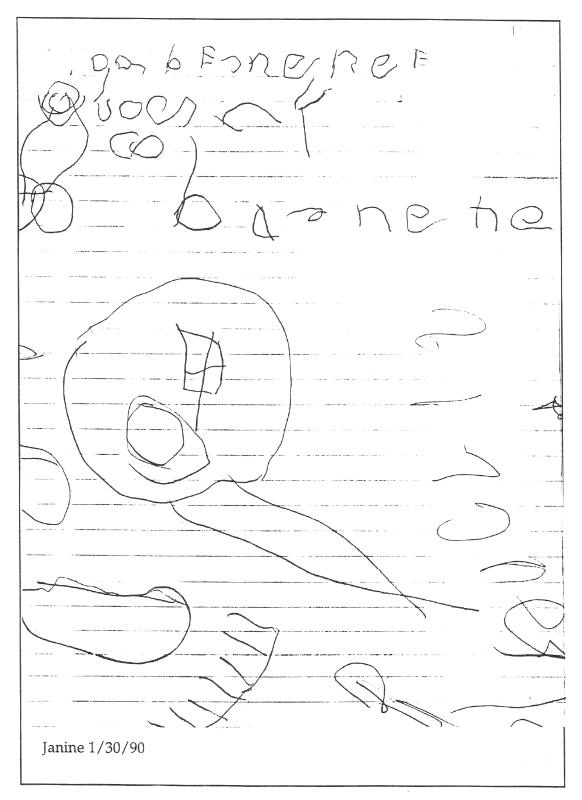
The children often decided in advance what their written products (i.e., drawings and writings) would look like and how they would achieve that product. The excerpts below help to illustrate how the children planned and organized their written products by being selective about which drawing and writing tools to use, manipulating space on their paper, and deciding how to use the tools they chose.
Excerpt from Field Notes (9/5/89, 12:20 P.M.):
Janine was writing on construction paper with a pencil. She drew a shape on the paper and then wrote a backwards s, a, 7, two circles, and a larger circle. Janine drew some more marks and then took out her eraser and looked at the picture for about thirty seconds. She decided to erase one small section and then colored the picture with a red crayon, holding it sideways as she shaded the picture.
Excerpt from Field Notes (10/2/89, 1:00 P.M.):
Jon was painting with sponges and corks, using four colors of paint. He made circles with the sponges and corks, grouping them on his paper by color. His work seemed to be planned and deliberate and Cathy and I commented to each other about this.
Excerpt from Field Notes (11/2/89, 9:55 A.M.):
Michael was writing his name on his chalk drawing. He wrote an M and then erased it with wet chalk. He wrote M again and then asked me if the next letter in his name was i. When I told him it was, he wrote it and then asked me to spell the rest of his name as he wrote it. When he got to the corner of his paper, Michael manipulated the letters around the corner so that the last three letters curved up from the bottom of the page.
Excerpt from Field Notes (11/3/89, 9:10 A.M.):
The children were drawing on construction paper with crayons. Michael drew a circular figure on his paper and then looked through the crayon box for the exact crayons he wanted. He colored over his figure with brown lines and drew wavy lines all along one side of his paper. Michael then folded his paper to take it home.
Excerpt from Field Notes (2/27/90, 1:20 P.M.):
Janine was making a thank-you card for the dentist the children had gone to visit. Cathy and Eileen took Billy to music and I stayed in the room with Janine while she finished gluing teeth on the front of her card. She started to take the card to her backpack and I told her to write her name first. Janine made writing marks with her finger as she vocalized. I gave her a blue marker and she said, “Two,” so I gave her the red one, also. She wrote each letter of her name in a different color except the two n’s (both in blue).
Risk-taking
The children decided when to take risks and what risks to take during literacy events. Although some of the children were hesitant to write in my notebook or on their artwork early in the year, they became more willing to take risks with writing as the year went on. The same was true for reading words and sentences on charts or in books. Throughout the year, each of the children took greater and greater risks as they engaged in literacy events: David, Michael, Billy, and Janine as they learned to write, Jon as he learned to read and spell his name, and Jeffrey as he learned to read. Rowcroft (1989), in a study of young writers, found that the children negotiated their participation in writing events and “exhibited a certain degree of risk taking in modifying the [social] contract [of the event]” (p. 29).
The excerpts below, from observations of Michael and Billy, typify the levels of risk-taking the children went through in learning to read and write.
Excerpt from Field Notes (9/29/89, 8:35 A.M.):
Michael took a slate board and marker and wrote an M for his name. Eileen, the teacher’s aide, went over to watch Michael. He made an M in fingerspelling and orally told her that he had written that letter. He next fingerspelled i and, by pointing to the slate board, asked Eileen to write an i for him. Eileen put her hand on top of Michael’s hand and helped him form the rest of the letters in his name.
Excerpt from Field Notes (9/29/89, 10:50 A.M.):
Michael took a book from the shelf and discovered it had a library sign-up card in the front. I told him that the sheet was for names and Michael pointed to my pencil and showed me that he wanted to write his name on the card. I gave him my pencil and he wrote an M and then wanted to erase it. He made a face and shook his head “No,” indicating that the M was not made correctly (although it actually was). Michael kept trying to write his name and erased it whenever he felt it wasn’t correct.
Excerpt from Field Notes (11/9/89, 8:30 A.M.):
Michael came over to me and took my pencil and notebook and wrote Mi. He then gave me the pencil and pointed to the paper and fingerspelled the rest of his name as I wrote it.
Excerpt from Field Notes (12/8/89, 9:50 A.M.):
Michael, while Cathy and the others were getting ready for recess, wrote his name on his artwork from this morning. This time, instead of erasing the letters or asking an adult to write or spell his name for him, Michael seemed pleased with his writing and proudly showed it to Cathy and me.
Excerpt from Field Notes (1/25/90, 10:30 A.M.):
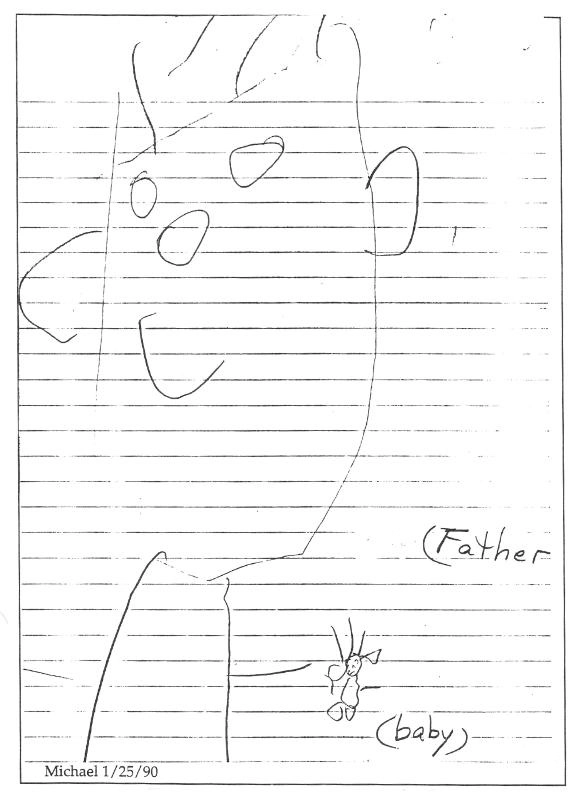
Michael drew a picture of his father and a baby in my notebook. The pictures were drawn proportionately with the father much larger than the baby. Next, he drew a picture of what looked like a house and a figure that he said was mother. I told him to write Mom and he did so without any hesitation or doubt about how to write it.
Excerpt from Field Notes (4/26/90, 10:55 A.M.):
Michael drew three cars and when I asked him to write car he drew two more. I then wrote car for him and he fingerspelled it when I asked what it said. On the next page, Michael wrote car and when I asked what it said, he drew a car.
Excerpt from Field Notes (4/27/90, 10:30 A.M.):
Michael asked for my notebook and wrote some letters. After I asked him several times what it said, he drew a picture of a car. On the next page he drew two cars and wrote R R R R and signed “car.”
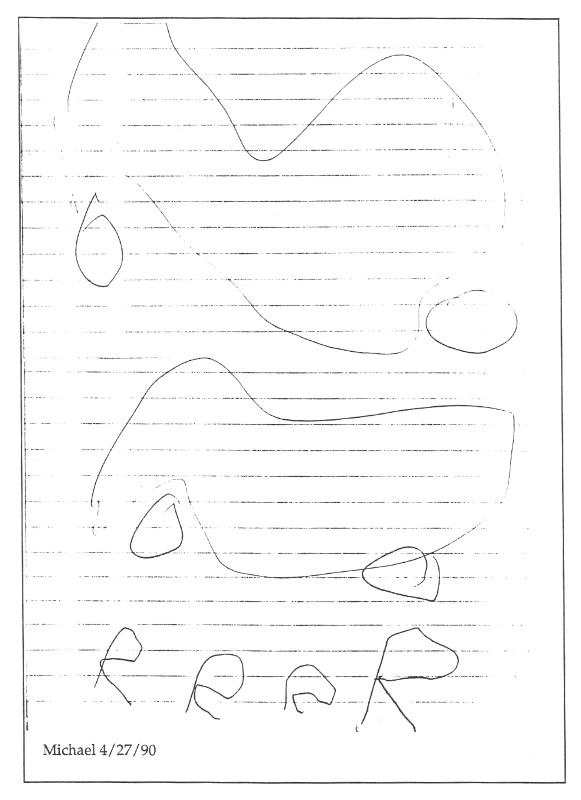
Michael moved from a low level of risk-taking to gradually higher levels: first asking for help in forming the letters in his name, erasing and continually correcting his writing, asking adults to write his name while he fingerspelled it, taking the risk to write his name without a model or assistance and using his own spelling convention, and, finally, beginning to invent spellings for words.
Billy also went through levels of risk-taking as he learned to write. Note, in the excerpts below, the parallels to the levels of risk-taking experienced by Michael.
Excerpt from Field Notes (11/13/89, 12:35 P.M.):
I tried to encourage Billy to write but he wouldn’t. He watched Janine as she wrote symbols and letters in my book and he seemed intrigued, but he still wouldn’t try.
Excerpt from Field Notes (11/21/89, 12:55 P.M.):
Billy watched Janine write and then he took a turn. He wrote some wavy lines across the paper and scooted away. About five minutes later, he came back and announced, “I’m gonna write again!” and he wrote quick, random, wavy lines on the paper and then ran off to play.
Later that day, Billy wrote his name on his art work after watching Cathy write it.
Excerpt from Field Notes (2/12/90, 2:20 P.M.):
It was book time and Billy came over to me and said, “I want to write.” I gave him my notebook and pencil and he drew a shape and some random lines.
Claire: What is that?
Billy: A horse.
I wrote horse on the paper for Billy and he copied it, spelling it as he wrote. Next, Billy drew a lion. I wrote lion and he copied it as before, saying the letters as he wrote them.
Excerpt from Field Notes (4/9/90, 12:20 P.M.):
Billy took my notebook and pencil and drew rabbit ears.
Claire: (as Billy drew rabbit ears) I bet I can guess what you’re drawing.
Billy: A bunny rabbit.
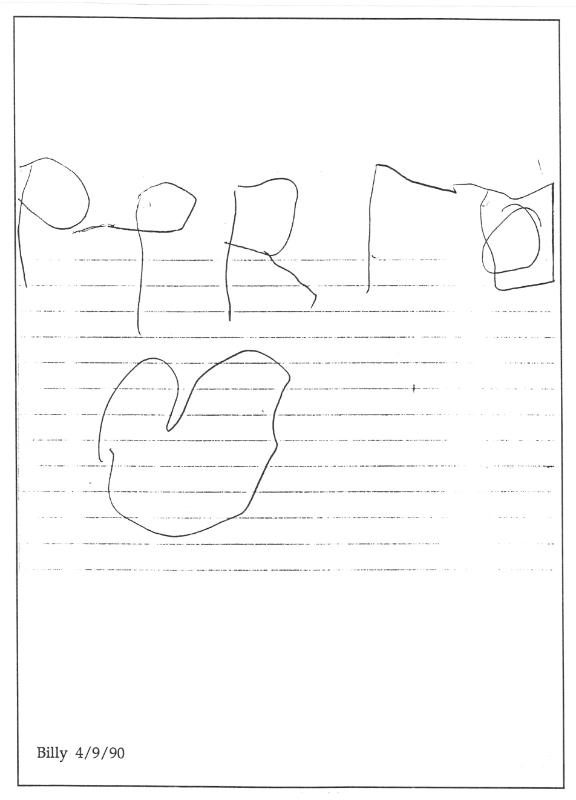
Billy finished drawing his rabbit and I asked him to write Bunny rabbit. Billy wrote t p r i. When I asked him what he wrote, he said, “Bunny rabbit.”
Janine came by and took her turn with writing in my notebook. After Janine finished, Billy took a second turn and started writing immediately. He wrote P P R I and said “Mama” several times as he wrote.
Excerpt from Field Notes (4/24/90, 1:00 P.M.):
Billy took my pencil and notebook and wrote letters that looked like Cathy’s name:
t C a h y
Claire: I know what that says. Cathy.
Billy: No, coyote.
Billy repeated the word coyote several times as he wrote and then told me about seeing coyotes when he went camping.
Generally, the classroom environment was one in which the children felt safe to take risks during literacy events. As a result, they made gains in literacy learning that might not have occurred if they had not had opportunities to experiment with written language. The preschool hearing-impaired children in a study by Ewoldt (1987) were also in an environment that encouraged risk-taking and her findings were similar.
No Choices
Although the children had a great deal of freedom in terms of participation and negotiation in literacy events, there were times when the children were not permitted choices. In addition, not all literacy events were options during free play. Writing or drawing, particularly with pencils, was usually available only through the use of my pencil and notebook. Rarely did Cathy provide drawing or writing tools as a free play choice. Also, when the children were involved with drawing or writing during art projects, Cathy denied the children access to pencils. For example, in the excerpts below, some of the children’s attempts to use pencils were aborted by Cathy.
Excerpt from Field Notes (10/13/89, 9:40 A.M.):
The children were following dotted lines to draw a bus. Darrell wanted to use a pencil that was in the crayon box but Cathy told him “Not the pencil” as he tried to take it.
Excerpt from Field Notes (11/3/89, 9:10 A.M.):
The children were drawing pictures on construction paper. Michael took a pencil from the crayon box and started to draw a second picture. Cathy, when she noticed Michael using the pencil, reacted with “Not the pencil. Use the crayons.”
Art activities were structured and Cathy had a product in mind that the children were expected to produce. For example, for Valentine’s Day the children’s cards to their mothers all had three hearts pasted on them in the same way. This type of activity and the emphasis on product and structure were not unique to Cathy’s classes. For instance, in studies by Rowcroft (1989) and Cook-Gumperz and Corsaro (1977) freedom of choice in art and writing activities was rare. These activities were teacher-selected and controlled and children had few opportunities for decision-making during these events. In Cathy’s classes, however, once the children had achieved the initial goal, they often had time to make decisions concerning their final product. For instance, in the excerpt below, Michael accomplished Cathy’s objective of following dotted lines for a picture of a bus and then made decisions about elaborating and giving meaning to his product:
Excerpt from Field Notes (10/13/89, 9:30 A.M.):
The children were drawing on papers with pictures of dotted line buses. After following the dotted lines for the bus on his paper, Michael drew windows and doors on his bus. His drawing was very intricate and he worked intensely on it. The others went out to recess and Cathy asked me to stay with Michael while he finished his work. He added lines to his window and then put a mark on top that looked like a person. I asked him what that was and, when he didn’t respond, I asked if it was a person and Michael shook his head “Yes.” Next, Michael drew a line across the top of his bus and then he drew a bus driver. He finished his picture by drawing a person in the bus.