Chapter 3: The Site
The research was conducted in a public elementary (K-6) school in a large suburban school district. This particular site was chosen for several reasons. First, it offered classes for preschool hearing-impaired children within a public school setting. The only other program available for hearing-impaired preschool children in the same geographic area was at a day school for the deaf. Second, the district appeared to have a positive attitude towards school-based research. It had a large research development division and a reputation for conducting research. Third, the site was easily accessible and, thus, made it conducive for the current research. The district, school, and classroom are described in detail in the sections that follow.
The District
The district was a unified kindergarten through twelfth grade school district in the largest of five suburban communities of a large metropolitan area. The city where the school district was located had at the time of the research a population of over 280,000 and covered an area of 102 square miles. The school district had approximately 60,000 students and 3,000 teachers at 43 elementary schools, 11 junior high schools, 6 high schools, and 3 special schools. The special schools included a school for emotionally handicapped students and a vocational high school.
The district had a strong central administration with a superintendent overseeing a superintendency of seven members, each with a specific responsibility (e.g., curriculum and instruction, educational services, health services, special education). The hierarchy of administration flowed down to associate and assistant superintendents and five regional directors of special education and then to school principals.
The District’s Philosophy of Education
From interviews and informal conversations with teachers employed by the district, I learned that the district had a philosophy of skills-based instruction and assessment. In terms of literacy, the district viewed reading and writing as separate processes that require learning hierarchical sequences of skills. The district emphasized the products of reading and writing as measured by standardized tests and competency-based tests. For example, to be considered a writer, a child must learn how to hold a pencil, form letters, and write words. Reading was viewed in the same way—a child must master the skills of phonics before he/she is thought to be a reader.
At various points during the year, the teacher in this study (Cathy) was observed administering district tests and evaluations to the children. These assessments were designed to measure the children’s growth in specific language and motor skills. For example, on October 12th, the teacher’s aide (at Cathy’s request), during classroom routines, marked on a checklist if the children could recognize their names, fingerspell their names, match colors, identify colors, and sequence colors. A month later, Cathy was observed administering individual assessments to the children. She had the children perform discrete tasks (or subskills), such as matching pictures or discriminating differences in pictures, as she recorded the children’s responses on a district assessment form. In addition, Cathy informed me that the Brigance (1989b, 1989c) motor and language tests were required twice a year by the district.
From observations and informal conversations with Cathy it appeared that curriculum scope and sequence was often mandated by the district. In an interview with an experienced special education teacher in the district, I was told that there were no district guidelines for the hearing-impaired program, but the district’s other programs were very structured and the curriculum was clearly delineated for regular classroom teachers. For example, there seemed to be a monthly thematic unit that most teachers followed. In December observations in several classrooms at different grade levels revealed a common theme—snow. One child was exposed to the story of Frosty, the Snowman in two different classrooms (preschool and kindergarten hearing-impaired classes) in one day and, in a first grade class for music that same day, sang songs about a snowman. This might seem like a typical winter day in many American schools and not necessarily reflect a district mandate; however, this occurred in an area that rarely, if ever, sees snow. This commonality of themes was observed on several other occasions throughout the year—one month several regular (i.e., not hearing-impaired) classes were observed studying dinosaurs and creating dinosaur art projects; November appeared to be fairy tale month; in January, nursery rhymes were popular in the hearing-impaired classes; community helpers were studied in several classes in February; and March seemed to be the month for Spring songs and poems.
Special Education in the District
From informal conversations with the classroom teacher and other teachers and through observations, much was learned about the district’s special education program, which was the most extensive for any district in that part of the state. The district provided services for most handicapping conditions with a total of at least twelve different programs, including hearing-impaired, visually handicapped, learning disabled, language delayed, emotionally handicapped, mentally handicapped (three categories), and physically handicapped, in both self-contained and mainstreamed settings for students in kindergarten through twelfth grade. Preschool services were provided for hearing-impaired, physically handicapped, and educable mentally handicapped children, ages three to five. Ample ancillary services were provided, including occupational therapy for all preschool handicapped children and for children who qualified in kindergarten through twelfth grade; the services of certified sign language interpreters for students in total communication classes and for parent conferences; audiology services for students enrolled in classes for the hearing-impaired; physical therapy for students with severe physical handicaps; adaptive physical education; and speech therapy for all hearing-impaired children. In addition, there were several program specialists who acted as liaisons between central administration and teachers. Special equipment also was provided for children with special needs. For example, each hearing-impaired child was supplied with specialized auditory equipment (often referred to as auditory training units) for use during school hours.
The district provided the preschool teachers with time for parent contacts, an element often missing from special education programs. The preschool hearing-impaired children attended school four days per week for two hours and forty-five minutes per day. The fifth day was considered a parent contact day and Cathy would spend much of that time making home visits.
The School
The school where the research was conducted was an elementary school (Grades K-6) located in a lower middle-class, ethnically mixed neighborhood. The school was bordered by private houses on three sides, with a junior high school (Grades 7-9) directly north of it and a high school (Grades 10-12) two blocks north of the junior high school. The district’s hearing-impaired program was based at these three schools with the children placed in self-contained programs and mainstreamed into regular classes when appropriate. The school where this study was conducted had two learning disabled resource classes in addition to four total communication and seven oral hearing-impaired classes.
The Physical Grounds of the School
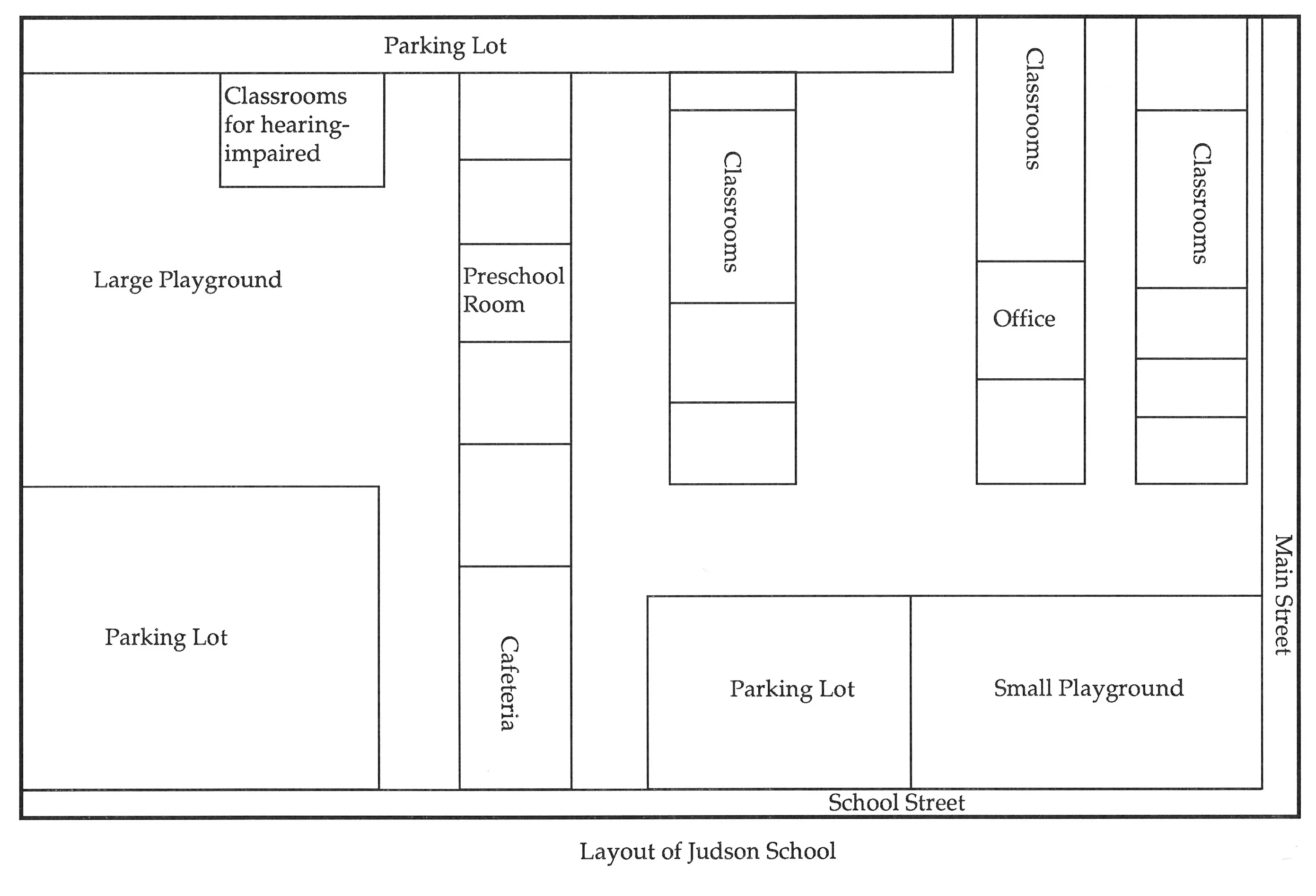
The school buildings were, at the time, approximately 36 years old. In addition to the school buildings, the grounds included three parking lots and two playgrounds. The preschool hearing-impaired classes used the smaller of the two playgrounds.
Safety at the school and on the small playground often was not optimal. Frequently, children would walk across the front parking lot as parents and others would be driving in and out. On several occasions, the principal made announcements over the loudspeaker in the morning addressing safety issues, such as running on the pavement or rock throwing. In addition, the gates to the small playground, one leading to the street and the other to the parking lot, often were left open.
The Principal
The principal of the school was a friendly, intelligent, and attractive woman. According to informal conversations with teachers of the hearing-impaired classes at the school, the principal was verbally supportive of the program, but lacked knowledge of deafness and deaf education.
Regular Classroom Teachers
There were approximately twenty-four regular classes at the school from kindergarten through sixth grade. According to Cathy and some of the other teachers of the hearing-impaired, attitudes of regular classroom teachers in the school towards the special education children and teachers were not viewed as positive. Some of the teachers were friendly, but most were not overly receptive to the program or to the idea of having the hearing-impaired children mainstreamed into their classes. Of course, there were exceptions, and some of the teachers were understanding and supportive of the program. For example, the teacher of the kindergarten oral hearing-impaired class worked cooperatively with one of the regular kindergarten teachers.
The Hearing-Impaired Program
The hearing-impaired program consisted of both oral and total communication classes. The children in the oral classes communicated using audition, lipreading, and speech. Most of the children in these classes had hearing losses ranging from mild to severe, although some children with profound hearing losses also were placed into the oral program. The children in the total communication classes communicated using primarily a manual sign system for English (Signing Exact English). The sign language system was often supported with audition, lipreading, and speech; however, many of the children in these classes had profound hearing losses, little intelligible speech, and limited lipreading ability.
Placement in the oral or total communication program was based on teacher recommendations and parental choice. The district’s central administration and the school’s principal had slight input in placement of children into the hearing-impaired program. Final placements were based on parent decisions. To qualify for the program, two conditions had to be present: an abnormal audiogram and difficulty functioning in regular classes. Most placements in grade levels were based on a child’s age rather than on abilities or levels of functioning. Mainstreaming into regular classes varied for each child and was determined by the classroom teacher.
The hearing-impaired program did not appear to have a cohesive group of teachers since the oral and total communication teachers were divided by philosophies. The oral teachers had a strong belief in giving hearing-impaired children the chance to function orally in the hearing world and sometimes were reluctant to place children in the total communication program. Many of them viewed total communication classes as a placement for oral failures. Cathy, the teacher of the preschool classes in this study, was caught in the middle of this controversy since she taught both an oral and a total communication class and was not committed to either view, but, rather, believed in using the mode of communication that appeared to be most effective for a particular child.