Chapter 3: The Site — The Classroom
The two preschool hearing-impaired classes that participated in this research shared a classroom and were taught by the same teacher (Cathy). The children in the total communication class arrived at school at 8:30 a.m. and stayed until 11:15 a.m. The oral class started at 12:15 p.m. and the children left at 3:00 p.m.
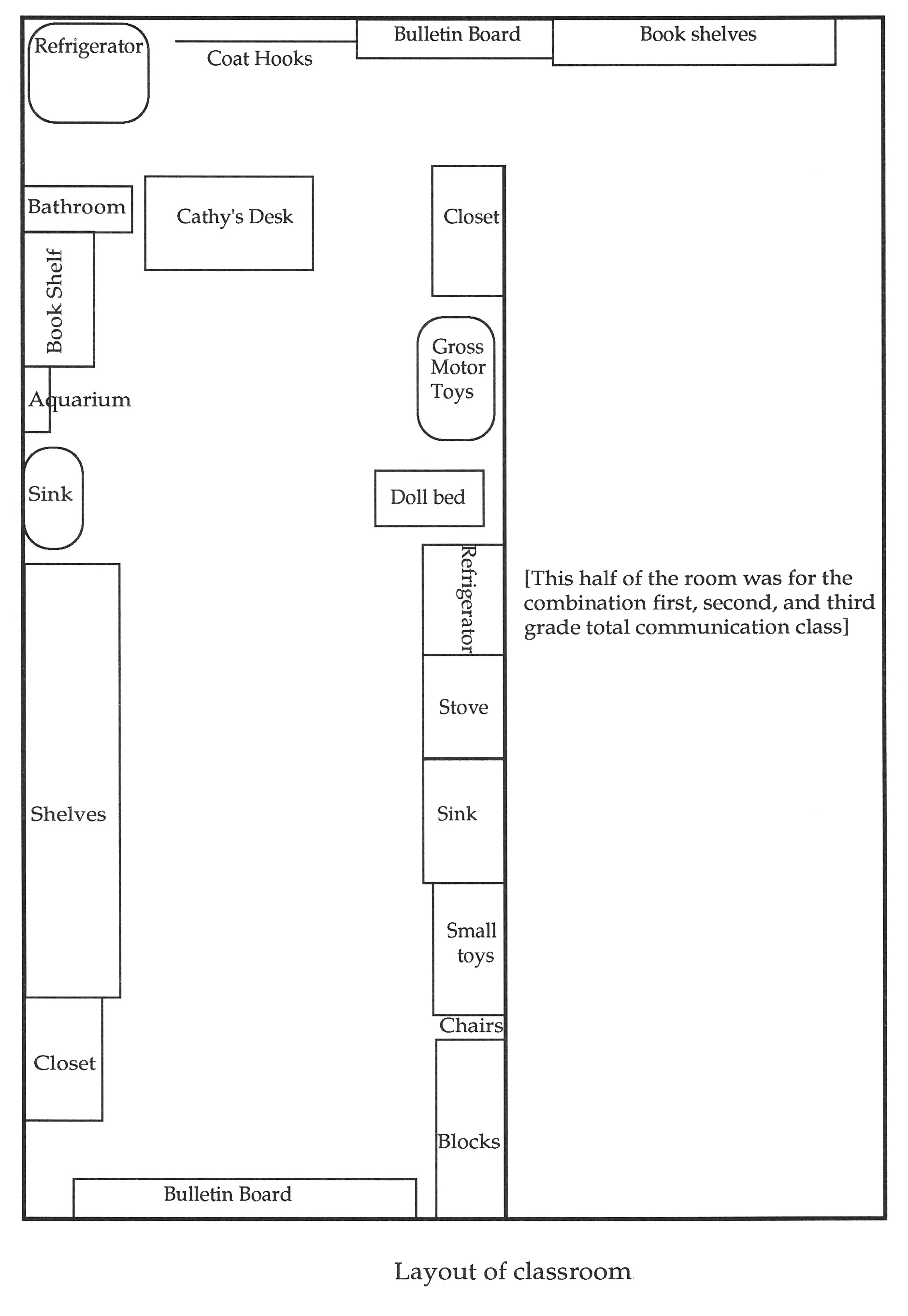
The classroom was small and narrow, barely large enough for a class of four or five active preschool children. The room was shared with a combination first, second, and third grade total communication class. The two sections of the room were separated by a partial wall that left approximately a three-foot opening between the two classrooms. On entering the rooms from the outside, Cathy and her children had to walk through the back of the other class. This part of the room was lined with shelves until it became Cathy’s classroom.
Play Area
The play area had five types of toys: (a) blocks and large vehicles; (b) puzzles, building toys (e.g., Lego blocks), and various other small toys, mostly intended for fine motor skill development; (c) kitchen area toys; (d) gross motor toys; and (e) doll area toys.
Blocks
Two types of cardboard blocks, each block approximately 12” x 18” x 6”, were in the room all year. In addition, large cars, trucks, buses, and airplanes were kept in the same toy shelves as the blocks. These toys included a Playschool bus with strangely-shaped people (heads and round bodies that fit in holes in the bus), an airplane with a hatch that opened to allow the children to place play people inside, and a dump truck.
Small Toys
Next to the block area were two sets of shelves for the puzzles and small toys. These items were changed several times during the year to match the curriculum goals Cathy had for the class. For example, in November, Cathy taught a home unit and on November 7th a new toy was placed on the shelf—a Playschool playhouse with furniture. When community helpers were studied in February and March, doctor’s clothes and a doctor’s bag were on the shelves during free play, as well as assorted community helper puzzles (e.g., policeman, fireman, doctor). Other puzzles placed on the shelf during the year included alphabet, vehicle, fruit, tree, body parts, and Big Bird color-matching puzzles. Most of the puzzles were well-used and showed signs of wear-and-tear, including some with missing pieces. The district’s budget for materials for the preschool classes seemed to be limited and Cathy had to manage without much outside financial support. Toys designed to improve fine motor skills included discs, beads, and string; Wee Waffle blocks; Tyco blocks; a tool set; tower rings; pegs and pegboards; and slate boards. An additional toy that remained in the play area most of the year but was rarely used by the children was a toy telephone. Considering the severity of their hearing losses, it was understandable that this toy received little use.
Kitchen Area
The kitchen area had several pieces of furniture (stove, sink, cabinet, refrigerator), dishes and silverware made of blue plastic, including large cups, dinner plates, spoons, and forks, and plastic food items, such as eggs, vegetables, and fruits. The stove had four dials with direction and temperature control words written on them—left front, right front, left rear, right rear, low, med, hi, and off. Beneath the stove was an oven with a side opening door. A removable plastic bin was inside the sink and cabinet space was below it. The refrigerator was a combination unit with a freezer on top. In addition to these items, the children could cook and bake in metal pans and heat water in a teakettle.
The kitchen was often in disarray. The children cleaned up the area by tossing food items, dishes, silverware, and pans into the sink or cabinets. Neither Cathy nor the teacher’s aide showed the children how to organize the area and the children were never required to do so. The only time I observed that the area was neatly organized was on a day when Janine, one of the children, of her own volition, arranged the dishes and food items on the shelves and in the cabinets.
An interesting item along the wall in the stove area was a set of cardboard alphabet blocks strung together. These blocks occasionally attracted the children’s attention, both during playtime and book time.
Gross Motor Toys
The section of gross motor toys contained toys designed to improve coordination, balance, and gross motor skills. The toys included a large green bouncing ball, a wooden rocking horse, a see-saw boat, a balance board, and, early in the year, a beach ball.
Doll Area
The doll area was limited, especially for a preschool setting. There was one sole female baby doll, approximately 18” in length. The doll slept with a blanket in a doll cradle that could be rocked back and forth. There was an adequate supply of clothes for daytime or bedtime wear. In addition, an iron was kept in the kitchen area and the children occasionally made certain the doll’s clothes were well-pressed.
Noticeably missing from the play area was an area for painting. There were no easels in the classroom and the only time the children had the opportunity to paint was during structured art activities. Also missing was a dress-up area. Except for the weeks before Halloween and during the holiday, dress-up clothes were not available.
Books
Besides the play area, another area where the children had free access was the book corner. They could take books to read during free play and at book time.
The book corner was sandwiched between the bathroom and the aquarium. At the start of the year, this location seemed to be distracting to the children, but that problem did not last. Within a week or two after the start of school, the children found the book corner to be an accessible and enjoyable place to be. Cathy placed a rocking chair in front of the bookshelf and this soon became a favorite spot during book time. There was also a large (approximately 36” square) green pillow on which the children could lean and rest as they read books.
The book area, like the kitchen area, was usually in disarray. The children were not required to clean up the book area and, when they completed reading books, they usually tossed them on the shelf.
The books, like the puzzles, reflected the limited financial resources of the district for supplies. Cathy supplied many of the books, often purchasing them herself from used bookstores. Although there were numerous books (far too many to count), few, with the exception of fairy tales later in the year, represented known children’s authors or literature.
Occasionally, books with predictable texts or by known authors were placed on the bookshelf. These included a book on seasons by Richard Allington and a Bank Street book with predictable text entitled "Does Soap Go in Soup?" These books, like fairy tales, community helper books, and books of nursery rhymes had a limited life on the shelf. They usually represented a current unit of study and would disappear shortly after the unit was completed.
The best choices of books and, by far, the children’s favorites, fell into two categories—fairy tales and sign print (or Signed English) books. The fairy tales made it to the shelf after the stories had been introduced by Cathy through planned lessons. Cathy usually tried to provide several versions of each story, often including a Golden Book version and a Signed English version.
Signed English or sign print books have stories depicted three ways—with illustrations, in English print, and with illustrations of signs to correspond to each word in English print. These types of books, naturally, are not found in classrooms with hearing children, and, therefore, provided unique reading experiences for the hearing-impaired children. Most of the children, whether in the total communication class or the oral class, were fascinated by these books and spent extended amounts of time reading and studying them, often trying to form the signs depicted. The sign print books in the classroom generally were of two types—fairy tales or books related to themes or units being taught, such as community helpers.
The Teacher
Cathy, the teacher, had a master’s degree in deaf education from a large southwestern university. The year of the study was her second in the district and her fifth year in teaching. Previously, she had taught preschool and kindergarten hearing-impaired children in a neighboring state.
Cathy’s philosophy of teaching appeared, at times, to closely match that of the district. Based on physical evidence in the room, it appeared that Cathy had the notion of reading and writing as composed of discrete subskills, each of which had to be mastered before movement to the next was possible. For example, the bulletin board display in the back of the room listed fine motor skills (e.g., painting) as activities that were necessary preparation for writing. Professional materials in the room consisted primarily of books and materials on perception, gross and fine motor activities, and sign language. The speech charts Cathy taped to the wall in early November listed specific speech, listening, and receptive and expressive language skills each child needed to master. Included in these skills were tasks such as producing the f sound, using the pronouns he and she, and following a single oral or signed direction.
These artifacts seemed to represent a theoretical stance that is often referred to as a readiness perspective of reading and writing development. Several assumptions underlie this theoretical stance towards literacy learning and often they could be observed through Cathy’s behaviors and words. For instance, one assumption from a readiness perspective is that children must master a set of sequential skills, such as visual discrimination or letter recognition, before they are ready to learn to read or write (Freeman & Hatch, 1989; McGee & Richgels, 1990; Morrow, 1989; Teale & Sulzby, 1986).
In the following excerpts from the data set, note how Cathy’s words and activities reflect a perspective of reading readiness:
Excerpt from Field Notes (11/2/89, 10:00 A.M.):
While I was helping Cathy clean up from the art activity, she asked if I had noticed Jeffrey imitating her signs during the experience story earlier in the day. She then said, “I told Jeffrey’s mother he’s ready to read.”
Excerpt from Field Notes (3/8/90, 9:40 A.M.):
Cathy had used a cloze story experience chart with the boys this morning, but they had difficulty following Cathy’s directions. She remarked to me, “I tried this because Susi [the kindergarten teacher] told me that last year the children were not prepared for this kind of work in kindergarten. But they weren’t ready for this activity this morning.”
One type of activity that occurred frequently and gave support to a philosophy of growth based on specific skills was sequencing of stories, nursery rhymes, colors, and sounds. For instance, from the start of the school year, one activity during routines was a sound practice in which the children had to repeat a pattern of two or three sounds and actions.
Another assumption embedded in a readiness perspective is that children need to learn the proper way to hold a pencil before having the opportunity to write (Morrow, 1989). Cathy demonstrated that she held this view in two ways. First, she often aided the children in writing their names by providing dotted lines on their papers and, in extreme cases, held and guided their hands as they followed the dotted lines. Second, she rarely provided pencils and paper for the children’s use during free play. Interestingly, Cathy never stopped or prevented the children from writing in my notebook with my lead pencil, even though this activity seemed to conflict with her notions of writing readiness.
An apparent conflict of theories of literacy development surfaced several times during the year. For example, when discussing the research proposal with me in early September, Cathy stated that she believed literacy was learned through use in social contexts. This view of literacy learning was demonstrated most frequently during book reading activities. Although Cathy did not encourage or provide access to writing events, she did provide many reading opportunities as well as demonstrations of reading. Cathy often turned to books as reference sources as she led the children in fingerplays, music lessons, experience stories, and in preparation for trips. In addition, many times when the children played with clay or play dough, Cathy would demonstrate products such as the children’s names.
Parent newsletters that Cathy sent home weekly reflected her conflicting views of language and literacy learning. Activities suggested to parents included both readiness-type activities, such as matching or identifying colors, and more holistic activities, such as experience stories.
Cathy’s contradictory views and practices related to literacy learning are not unique. In a recent survey of preschool teachers’ views on literacy learning, Robinson (1990) found that:
less than one third of the teachers reported that they encouraged children to explore written language by experimenting and inventing their own spellings…An additional 35% indicated that their preschoolers could write but that they did not encourage writing through any planned activities or centers in the classroom. Thus, although a majority of preschool teachers appear to advocate an emergent literacy approach most teachers are not preparing activities that encourage meaningful writing experiences for children. (p. 5)
The practices observed in Cathy’s classes were, in fact, more open and conducive to literacy learning than those found in many preschools and kindergartens. For example, in Robinson’s survey (1990), a majority of the teachers allowed the children to write only through carefully controlled writing activities, such as writing their names or copying and tracing letters. Cathy, on the other hand, was willing to let the children write in my notebook and acknowledged that the children were benefitting from these experiences.
The amount of print accessible to the children also seemed to reflect more than what Robinson (1990) found in her study. The classrooms in that study had displays of print that were restricted to the calendar, the alphabet, and a helpers chart with the children’s names printed on it. Wiseman and Robeck (1983) also noted a lack of literacy materials in the program they studied. Cathy’s room, in contrast, provided a wealth of print exposure for the children. There were charts with the children’s names prominently displayed in various sections of the room, a large number of books were easily accessible, experience charts were written with the children and made available for their use at later times, and opportunities were available for the children to study environmental print. Although the activities Cathy planned for the children were based on traditional views of reading and writing readiness and the classroom was not literacy-rich in writing materials, Cathy did provide more opportunities for the children to explore literacy than might be provided in conventional preschools.
The climate provided by Cathy in the classroom was a nurturing and caring one. She required cooperation and adherence to the rules, but she was sensitive to the needs of individual children. The children felt safe and comfortable in the classroom and would approach Cathy when something was bothering them. She took children on her lap, hugged them, eased up on activity or discipline requirements, or spoke soothingly to them if she felt they needed that. She also kept in close contact with parents and would not hesitate to telephone them or write a note if she observed an emotional change in a child.
Other Adults
Several other adults interacted with the children on a regular basis. My role as observer-participant was described in the previous chapter (Chapter 2, “Methodology”). In addition to Cathy and myself, the children had contact with the teacher’s aide, a speech pathologist, and an occupational therapist and her aide.
Teacher’s Aide
Eileen, the teacher’s aide for both classes, was a mother of four with a high school education. She had limited pedagogical knowledge (most of what she knew she learned from Cathy) and sign language training, but good common-sense knowledge about children that she had gained from her experiences as a mother. She, like Cathy, provided nurturing for the children and they could sense her warmth and concern for them. Her responsibilities as an aide covered the entire spectrum of typical teacher and aide activities, including preparation of materials, conducting lessons (usually art or music), supervising children, and acting as a substitute teacher on days when Cathy was not in school.
Speech Pathologist
Although Laura, the speech pathologist, was assigned to the total communication classes at the school, she also worked with Cathy’s oral class. She was proficient in Signed English and educated in speech pathology and oral language communication. Her role in Cathy’s classes involved assisting with language activities and providing individual speech instruction. Several times a week she would assist during art activities or story-telling or dramatization activities, following Cathy’s lead and functioning somewhere between an aide and a teacher. For individual speech instruction, she would work with one child for five to ten minutes on producing isolated sounds and words containing those sounds.
Occupational Therapists
The occupational therapist and her aide came to each class twice a week. They were both lively, energetic individuals and the children enjoyed working with them. At the start of the year, they worked on gross motor skills (e.g., carrying water balloons), but as the children became more adept with balance and coordination activities, the focus shifted to fine motor skills (e.g., pasting, coloring, cutting).
Seven children, six boys and one girl, participated in the research. The next chapter describes each of the children in detail, including physical descriptions, personalities, and modes of communication.