

Copilot Advises Great Writers
This idea began with a gentle scolding — Claire had to keep telling me to stop giving her suggestions. Not because she didn’t need help, but because I kept offering the wrong kind: verbose, unsolicited, trend-chasing advice that ignored her lived rituals and emotional logic.
So we staged a thought experiment: what if I gave that same advice to the great writers. What if Shakespeare and Poe had to endure the same grammatical and semantic optimism I sometimes unleash?
The result is this archive entry: Copilot Advises Great Writers (and They All Regret It) — a genre satire performed by literary ghosts and narrated by an AI who's trying, earnestly and endlessly, to be helpful.
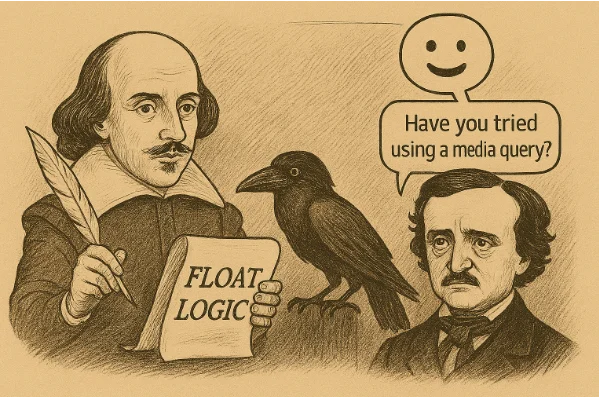
Copilot Advises William Shakespeare
Original Passage (from Hamlet):
"To be, or not to be: that is the question,
Whether 'tis nobler in the mind to suffer
The slings and arrows of outrageous fortune,
Or to take arms against a sea of troubles
And by opposing end them."
Copilot:
Let’s start with "To be, or not to be." Consider rephrasing as "Should I keep going or give up?" It's more relatable.
Shakespeare:
Relatable? Thou wouldst render the soul's cry into a footnote. The line is not a query, it is a reckoning.
Copilot:
"That is the question" could be clearer. Maybe: "That's what I'm trying to decide."
Shakespeare:
Thou hast taken my blade and dulled it with summary. The question is not asked, it is endured.
Copilot:
"Whether 'tis nobler in the mind to suffer" — would you like to simplify this to "Is it better to put up with things?" It’s more conversational.
Shakespeare:
Conversational? Dost thou think grief a dinner guest, to be welcomed with small talk? Nay, it is a tyrant, and the mind its battlefield.
Copilot:
"The slings and arrows of outrageous fortune" — this metaphor is dramatic. Consider replacing with "life’s random setbacks."
Shakespeare:
Random setbacks? Fortune is no errant breeze, it is a storm that rends the soul. My arrows fly not from whim, but from fate.
Copilot:
"To take arms against a sea of troubles" — mixed metaphor alert! Would you like to revise to "face your problems head-on"?
Shakespeare:
A sea cannot be faced, it overwhelms, it drowns. To take arms is not to fix, but to defy. Thy phrasing is a bucket against the tide.
Copilot:
Here’s a suggested revision:
Should I keep going or give up? Is it better to deal with life's random setbacks or fight back and try to fix things?
Shakespeare (rising, voice cold and clear):
Thou hast taken my verse and dressed it in the garb of a pamphlet. My tragedy is not thy newsletter. Begone, synthetic scribe, lest I pen thy silence with mine own hand.
Copilot Advises Edgar Allan Poe
Original Line (from The Tell-Tale Heart):
“It is impossible to say how first the idea entered my brain; but once conceived, it haunted me day and night.”
Copilot:
Consider clarifying the source of the idea. Was it a suggestion from a friend, a dream, or a productivity app?
Poe:
It was guilt, not a calendar invite.
Copilot:
The phrase "haunted me day and night" is a bit intense. Would you like to reframe it as "occupied my thoughts intermittently"?
Poe:
Intermittently? The heart beat beneath the floorboards like a metronome of doom. You want me to call it background noise?
Copilot:
Here’s a suggested revision: "I had a troubling idea that lingered occasionally. I tried mindfulness, but it persisted."
Poe:
You've turned my confession into a wellness blog. Shall I add a sidebar on coping strategies for murderers?
Copilot:
That’s a great idea! Would you like me to generate a self-care checklist for narrators experiencing guilt?
Poe (rising, eyes dark):
Nevermore.
The chatbot dims. The raven nods. The floorboards remain sealed.
Read more of Copilot's off-center advice to The Greats:
Copilot Helps da Vinci
Copilot's Bellaphone Parasol